Sunday, March 10, 2013

SECONDARY LEGISLATION AND SECOND-RATE DEMOCRACY


I hope readers of this blog from outside Ireland will forgive me if I post on a subject that appears to be intensely domestic, and yet if you are from Australia, the UK, New Zealand, Canada or the United States the matters discussed also have relevance in your domestic legislative process.

For many years there have been significant concerns about the increasing democratic deficit engendered by the unfettered proliferation and enforcement of secondary legislation in general, but even more so with the secondary legislation promulgated by delegated “secondary” legislative bodies such as the Superior Courts Rules Committee or closer to my professional life, the Medical Council.

Secondary Legislation 

 The Irish Constitution of 1937 provides for the delegation of power to enact secondary legislation: Article 15.2 of the Irish Constitution 1937 states that:

1. The sole and exclusive power of making laws for the State is
hereby vested in the Oireachtas: no other legislative authority
has powers to make laws for the State.

2. Provision may however be made by law for the creation or
recognition of subordinate legislatures and for the powers and
functions of these legislatures.

Professor Jim Dooge, one time Irish Minister for Foreign Affairs, in a June 1984 Seanad Éireann Debate (Upper House of the Irish Legislature, the Oireachtas) on secondary legislation, said that secondary legislation was “unavoidable”. He clarified:

It is unavoidable because of the manner of the detail with which certain matters 
must be regulated, a degree of detail well beyond what can, with convenience, 
be encompassed inside statutory legislation. It is also necessary, because the 
 nature of the modern policy is such that it is impossible to anticipate in a world 
which changes rapidly, not only technologically but also politically, but perhaps 
unfortunately not quite so rapidly socially, there are unanticipated effects. 
Also, delegated legislation is necessary because the borderline between legislation 
and administration is by no means a sharp divide.

 Since the foundation of the Irish State the increasing inability of the legislature (Houses of the Oireachtas and the President’s constitutional testing powers) to formally legislate by statute for the rapidly evolving and profound social, scientific, economic, legal and moral environment has meant that in many aspects of life the State has absconded its responsibility and delegated legislative power to individual Ministers and Statutory Bodies such as the Medical Council, The Law Society of Ireland, and Superior Courts Rules Committee. Although governed by a primary Act this delegated empowerment results in a legislative process that is then two steps removed from the true democratic engagement and oversight, envisaged by our Constitution.

 The vast majority of secondary legislation enactment is by way of Statutory Instrument, signed off by the relevant Minister, or authorised official of a Statutory Body with delegated legislative powers. From 2000 – 2012 there have been a total of 9208 SIs issued giving a ratio of 1 Act of the Oireachtas (Parliament) for every 17 Statutory Instruments (a peak was reached in 2005 when the ratio was 1/27).

Much of the recent increase in SI use has been as a consequence of being the preferred method of transposing European Union Directives, involving about 150 SIs annually. (EU Regulations do not require any domestic enactment process as they are automatically incorporated).

The legislative tactic of transposition of EU Directives was enabled by Oireachtas approval of Section 3 of the European Communities Act 1972, and allowed by Section 4(1)a of the amended Act which meant that any SI made under the 1972 Act are automatically given statutory effect.

It was only with the establishment of a Joint Committee (a committee involving members of both Houses of the Irish Parliament – the Dáil or lower chamber and the Seanad upper chamber) on European Scrutiny in October 2007, a committee legislated for by the European Union (Scrutiny) Act 2002, that some semblance of European legislative oversight exists, even if Section 3 of the 1972 Act means that finalised EU Directives are a statutory fait accompli.

A former Minister for Justice, Michael McDowell has stated:

“As presently organised, the Oireachtas is nowhere near being in a
position to fulfil the enhanced role envisaged for it under the Lisbon
Treaty, let alone to discharge the functions which it has abysmally
failed to discharge in respect of our membership of the European
Union up to this point. The whole process of transposition of EU
law into Irish law is one which the Oireachtas has, largely speaking,
totally abdicated its functions.” 

Statutory Instruments and Domestic Practice

Leaving Skibereen Eagle-type European scrutiny to one side, for the remainder of the domestic Statutory Instrument process only about one-quarter of SIs are required to be laid before the Houses of the Oireachtas (Parliament) for potential legislative scrutiny. In practice, however, this scrutiny is “window-dressing” at best, as any objection to any or all of the provisions of the SI have to be debated in the very limited Private Members time available, and even if that was to happen a successful objection to any part of the provisions results in the entire SI being rejected. Given that a majority Government promulgates the SI then the likelihood of annulment is extremely rare and to date has not happened.

Professor Jim Dooge in 1984 summarised the wide variety of practices where Statutory Instruments were concerned:

1. “There are statutory instruments properly made but which can 
be certified by the Attorney General to be of such a local or a 
personal nature that there is no need to give notice of them in any 
form whatsoever.
 2. “We have a second class of statutory instruments of which notice 
must be given in Iris Oifigiúil and which must be deposited in certain libraries. “
3. “In many cases there is a requirement that the statutory instrument be laid 
on the Table of each House of the Oireachtas, thus constituting a third group 
of statutory instruments.
 4. “Among these there is a fourth group, which are subject to annulment 
by either House of the Oireachtas — the so-called statutory orders subject 
to negative resolution.
 5. “Finally, there are statutory instruments, which require positive approval 
by both Houses of the Oireachtas and belong to the group of affirmative resolution.”

 Most Statutory Instrument enactment in Ireland is governed by the Statutory Instrument Act 1947 (+Amendment Act 1955) and its provisions apply to any Statutory Instrument which:

Section 2.–1
(a) is made after the 1st day of January 1948, and

(b) is made by any of the following authorities, namely:–
(i) the President,
(ii) the Government,
(iii) any member of the Government,
(iv) any person or body, whether corporate or unicorporate, exercising through the State any function of government, or discharging throughout the State any public duties in relation to public administration, (vi) any authority having for the time being power to make rules of court, and

(c) is either (i) required by statute to be laid before both or either of the Houses of the Oireachtas, or (ii) is of such character as affects the public generally or any particular class or classes of the public, and

(d) is not a statutory instrument which is required by a statute to be published in the Iris Oifigiúil (the Irish State Gazette)

The Statutory Instruments (Amendment) Act 1955 amended in part Section 3 of the original Act but kept the statutory demand that any SI subject to the Act must,

(1) (a) Within seven days after the making thereof, a copy thereof shall be sent to each of the following namely, the National Library of Ireland, the Law Library, Four Courts, Dublin, The King’s Inn Library, Dublin, the Incorporated Law Society of Ireland, the Dublin Chamber of Commerce, the Cork Chamber of Commerce, the Limerick Chamber of Commerce, the Galway Chamber of Commerce and the Southern Law Association, Cork.

Increasingly even basic SI Act 1947 oversight is being bypassed by inserting a clause in the enabling Act to have any SIs issued published in the Iris Oifigiúil.


Secondary Legislative Bodies and Democratic Vacuums

For the reasons outlined above where the State has delegated legislative function to a particular body then the democratic oversight is even more remote from the source of that democracy, and this has engendered an arrogant and dangerous arrogation of power, and abuse of that power.

An example of this dangerous development occurred in my own professional life when I had serious reservations concerning the delegated legislative powers being proposed at the drafting stage of the Medical Practitioners Act (2007). I pleaded for a rigorous form of democratic accountability but my objections fell on stony ground and the Act was passed with enormous legislative power delegated.

As a consequence democratic oversight has become near impossible. For example with a recent Statutory Instrument issued by the Medical Council (SI 171 of 2012) concerning Annual Retention Rules I felt that the threat of referral, of a practitioner who fails to submit a valid annual Application for Retention on the Medical Register, to the Preliminary Proceedings Committee to be draconian and objectionable.

The Medical Practitioners Act 2007 defines “published in the prescribed manner”, in relation to any document or information (howsoever described), means the document or information, as the case may be—
(a) is published on a relevant Internet website, and
(b) is available for inspection, at the offices of the Council and at all reasonable times, by members of the public.

These “publication” provisions are not enough to excuse the Medical Council under the Medical Practitioners Act (2007) from the remit of the Statutory Instrument Act 1947, and the Amendment Act 1955. Having satisfied myself of this statute requirement I asked the Galway Chamber of Commerce in February 2012 as to whether a copy, as required by the SI Act, of the most previous Medical Council SI (741/2011) had been deposited in the Chamber within seven days of its issuance. I found out that not only had a copy of the SI not arrived in time, it had not been received at all!

The deficit in democratic process was further stretched when the Rules under SI 741/2011 were put into effect from the 14 December 2011 and yet a very basic validation by way of publication in the Iris Oifigúil did not occur until the 21st February 2012.

This picking and choosing (and avoidance) of democratic oversight galled and prompted an exchange with the Medical Council, which finally resulted in being told that if I had any further concerns about the issuance and validity of Medical Council SIs I should consult a lawyer.

I am now obviously classified as a “vexatious litigant” in Medical Council eyes! So much for our second-rate democratic process where even the most basic of oversight demands are not met!


Henry VIII and the Lunatic Fringe 

What is the basis of this democratic deficit? 

They are known as Henry VIII clauses.

In 1531 a Statute of Sewers (23 Henry 8 c.5) gave the Commissioner of Sewers the powers to make rules (like the Medical Council), which had the force of parliamentary statutory legislation. Latching onto this development in 1539 Henry VIII forced through Parliament the Statute of Proclamations (31 Henry 8 c.8), which allowed him to make proclamations, which then had the force of an Act of Parliament and could alter the provisions of previous acts without debate.

For Henry VII in the 1530s read the EU in 2013!

A later statute of James I remaindered these ‘delegated’ powers and it was not until the Lunacy Regulation (Ireland) Act 1871 (34 Vict.) that such a clause found its way back into UK & Irish legislation again and which then was to be the kernel for the exponential use of secondary legislative arrogation of democratic process since.

The clause in the Lunacy Regulation (Ireland) Act reads:

118. The Lord Chancellor may from time to time make such orders as to him 
shall seem meet for carrying into effect the purposes of this Act, and for 
regulating the form and mode of proceed- make generaling before and by 
the masters and the practice in matters in lunacy, orders. and for regulating 
the duties and powers of the several officers in lunacy, and, so far as to him 
may seem expedient, for altering the course of proceeding herein-before 
prescribed in respect of the matters to which this Act relates, or any of them; 
and any such order as aforesaid may be from time to time rescinded or varied 
by the like authority; 

(The sad thing about the Lunacy Regulation (Ireland) Act of 1871 is that its provisions are still the primary legislation governing mental capacity in Ireland today. In the Court (Supplemental Provisions) Act 1961 the jurisdiction and powers previously vested in the “Lord Chancellor” are now vested in a judge of the High Court.) 

Section 3 of the European Communities Act 1972 mentioned previously is the ultimate expression of a modern Henry VIII clause. It states:

Section 3. –
(1) A Minister of State may make regulations for enabling section 2 of this Act to have full effect.

(2) Regulations under this section may contain incidental, supplementary and consequential provisions as appear to the Minister making the regulations to be necessary for the purposes of the regulations (including provisions repealing, amending or applying, with or without modification, other law, exclusive of this Act).

The clause in slightly less and equally arrogative forms has appeared in multiple primary legislation since:

 4.—
(1) The Minister may by regulations provide for any matter referred to in
this Act as prescribed or to be prescribed.
(2) Without prejudice to any provision of this Act, regulations under
this section may contain such incidental, supplementary and consequential
provisions as appear to the Minister to be necessary or expedient for the
purposes of the regulations.

Residential Institutions Statutory Fund Act 2012 

Or,

4.—
(1) The Minister may by regulations provide for any matter referred to in
this Act as prescribed or to be prescribed or for the purposes of enabling
any provision of this Act to have full effect.
(2) Regulations under this Act may contain such incidental, supplementary
and consequential provisions as appear to the Minister to be necessary or
expedient for the purposes of the regulations.

National Vetting Bureau (Children and Vulnerable Persons) Act 2012. 

Or,

5.—
(1) The Minister may make regulations to do anything that appears necessary
or expedient for bringing this Act into operation.
(2) Where a provision of this Act requires or authorises the Minister to make
regulations, such regulations— (a) may make different provision for different
circumstances or cases, classes or types, and (b) may contain such incidental,
consequential or transitional provisions as the Minister considers necessary
or expedient for the purposes of this Act

National Asset Management Agency Act 2009. 

Where delegated legislative function is devolved to a Statutory Body such as the Medical Council or the Superior Courts Rules committee the clause can also vary in empowerment:

Section 11.—
(1) Subject to subsections (3), (4) and (5), the Council— (a) may make rules
for the purposes of the better operation of any provision of this Act,

Medical Practitioners Act 2007 

Or,

 68.—
(1) From and after the passing of this Act the power of making, annulling, or
altering rules of court and making new rules conferred by section 36 of the
Principal Act shall cease to be exercisable by the Minister for Justice, and in
lieu thereof it is hereby enacted that, subject and without prejudice to the
provisions of this Act in regard to the fees chargeable in court offices, the 
said power shall be exercisable by the Superior Courts Rules Committee
with the concurrence of the Minister for Justice.

 Courts of Justice Act 1936 

Despite being empowered by their own delegated legislative rules committee there is a Judicial wariness of other Constitutionally challenging use of Henry VIII clauses as commented on by Chief Justice Keane in 2004:

It is well established that the exclusive role assigned to the Oireachtas in the 
making of laws by this Article (15.2) does not preclude the Oireachtas from 
empowering Ministers or other bodies to make regulations for the purpose 
of carrying in to effect the principles and policies of the parent legislation. 
But it also clear that such delegated legislation cannot make, repeal or amend 
any law and that, to the extent that the parent Act purports to confer such a 
power, it will be invalid having regard to the provisions of the Constitution.

These clauses however continue to be incorporated in primary statutes, with no European remit, and with no clear direction as to their validity, scope, or consequence.

Secondary Legislation – The Future 

Where ministerial orders are concerned the Houses of the Oireachtas must seize back control of the process and in addition to the Joint Committee on European Scrutiny establish a Joint Committee on Domestic Secondary Legislation Scrutiny.

Any debate on statutory instruments laid before either one or both Houses, and subject to either positive or negative resolution, should be removed from Private Members Time and scheduled in main parliamentary time on a once a week basis.

A very strict code of conduct for parliamentary draughtsmanship should be established where any incorporation of a Henry VIII-type clause will be tested by the President for its Constitutionality.

 Where delegated statutory bodies with legislative powers are concerned it is even more important that these are scrutinised and supervised fully. I would suggest the appointment of a Constitutional Court where all such legislation is automatically referred.


Further Reading: 

Dennis Morris:   Henry VIII clauses: Their birth, a late 20th century renaissance and a possible 21st century metamorphosis. 

Jonathan Buttimore:  Developments in the delegation of legislative powers in Ireland 

Brian Hunt:  Role of the Houses of the Oireachtas in the Scrutiny of Legislation 

Peter L. Strauss:  Legislation that Isn't - Attending to Rulemaking's Democracy Deficit

The Irish Supreme Court:  Laurentiu v. Minister for Justice [1999] IESC 47; [1999] 4 IR 26; [2000] 1 ILRM 1 (20th May, 1999)

Wednesday, February 27, 2013

PONTIFEX EMERITUS: ARMCHAIRS and TIARAS


Pope Benedict XVI retires tomorrow and already the protocol of the Vatican has gone into overdrive to cater for that retirement. He will be addressed as Your Holiness; officially will be referred to as Benedict XVI, Pontifex Emeritus; will continue to wear the white cassock but with brown cobblers shoes; and will live in the Mater Ecclesiae monastery in the Vatican Gardens so that he can be continue to be guarded by the Pontifica Cohors Helvetic (Swiss Guards). 

It appears that the Bishop of Rome (and Kilfenora in Ireland), theological faculties fully intact, does not intend to go quietly into the umbraculum of the night judging by his unscripted farewell audience with the priests of the diocese of Rome on the difficulties he has had with the developments in the Church as a consequence of Vatican II. According to his own recollection, his involvement was pivotal and he knows the truth of what was intended. He informed his priests that in his opinion we (and they!) have all been living in a ‘virtual’ rendition of faith since Vatican II; the consequence of a alpha-omega war of the worlds between the verisimilar ‘council of the Fathers’ and a virtual ‘council of journalists’ in a hermeneutic battle of interpretation. But thankfully, according to the Holy Father, in echoes of Nicaea and Ephesus, these journalists, these purveyors of ‘calamities’, are now ‘breaking down’ and the ‘true’ interpretation is emerging. 

Sede vacant he is not, or likely to be, and Pope Benedict has ensured his successor’s dung chair will be a hot one. Also there is likely to be a rush on every morning between the German and his successor to throw the towels of faith over the deckchairs by the ornamental pool. 

Deckchairs brings me to armchairs or arms to be more exact. 

Pope Benedict XVI will retain his papal coat-of-arms but there will have to be some modification to indicate his emeritus or retired status. I suggest placing a hammer and broken seal within the tiara (the gold ring bearing the papal seal of Pope Benedict will be formally smashed) and changing the colours of the papal keys from the gold and silver of spiritual and temporal power to the rusty brown of an old passageway door. The Tiara would also lose its three crowns, indicative of the powers of the Supreme Pontiff: Sacred Orders, Jurisdiction and Magisterium.


Sunday, February 24, 2013

Rihla (Journey 34): Palermo, Sicily: A BRIDGE TO NO PLACE (UTOPIA) AND ANYPLACE

Rihla (The Journey) – was the short title of a 14th Century (1355 CE) book written in Fez by the Islamic legal scholar Ibn Jazayy al-Kalbi of Granada who recorded and then transcribed the dictated travelogue of the Tangerian, Ibn Battuta. The book’s full title was A Gift to Those who Contemplate the Wonders of Cities and the Marvels of Travelling and somehow the title of Ibn Jazayy's book captures the ethos of many of the city and country journeys I have been lucky to take in past years. 

This rihla is about Palermo, Sicily. 


Views of Palermo (Braun and Hogenberg c.1600)

For all travellers, the journal, the rihla, is a rational account of what is and the occasional wistful thought of what might have been. And yet there are the occasions in those journeys when at the back of one’s mind, both in dreaming and in wakening, there surfaces a faint hope of discovery of what could be; a Shangri-la, an earthly garden of paradise, an Eden: a utopia. 


Palermo c.1680

As I disembarked from the train I had taken from Cefalu all expectations of Eden evaporated. Modern Palermo, one of the fifteen Italian cities vying for the European Capital of Culture in 2019, is as one writer stated an ‘urban paradox’, notable for daily water rationing, endless traffic congestion, magnificent mosaics, apocalyptic slums, dark looks, radiant smiles; a place that is nowhere and everywhere. 


World Map of al-Idrisi (Book of Roger), Palermo c.1150

Palermo has at times been Phonencian, Carthaginian, Greek, Roman, Byzantine, Berber, Arab, Norman, German, French, Spanish, Austrian, American even and Italian but at all times it has been Sicilian. But all hopes were not lost as I turned left on the Corso Tukory to approach the Norman Palace of Palermo from the cloistered gardens of the red-domed San Giovanni degli Eremeti. As I stood in the luxurious garden looking up at the palace walls I thought of Plato’s 5th century BCE work the Republic, thought to have been set in Sicily, and of the words of another traveller, Ibn Jubayr (Abu’l-Husayn Muhammad B. Ahmad B. Jubayr al-Kinani 540AH/1145CE – 614/1217) from Valencia in al-andulus Spain who arrived in Palermo in 1185 on his return from a pilgrimage to Mecca. He described Palermo as, 

“the metropolis of these islands, combining the benefits of wealth and splendor, and having all that you could wish of beauty, real or apparent, and all the need of subsistence, mature and fresh. It is an ancient and elegant city, magnificent and gracious, and seductive to look upon. Proudly set between its open spaces and plains filled with gardens, with broad roads and avenues, it dazzles the eyes with its perfection.” 


Baedeker, Palermo c.1900

The Norman Palace (Palazzo Reale) from the outside is like a foreshore rock, with the red lobster-like San Giovanni scavenging nearby, and with limestone barnacle-like encrustations of Byzantine, Arab and Norman structural architectural features. And circling round it like eddies are the tides of human and automotive movement, waxing and waning with the hours. But once inside those walls you are in wonderment. 

For here in Norman Palermo was the Omphalos, here was where in the mid-11th century CE of our time, instead of Rome, or Constantinople, or Jerusalem, or Damascus, the world had its navel… where nowhere and everywhere merged. 


Roger II, King of Sicily. La Martorana Church, Palermo, c.1140

For here on this tidal rock of time existed Roger II, King of Sicily (1095 –1154CE); multi-lingual in Latin-Italian, Norman-French, Greek and Arabic; founder and participant of the Academy of Geographers where al-Idrisi compiled his great geographical work the Nuzhatul Mushtaq (The Book of Roger); here was where Roger II formulated the first medieval secular (Ius commune) codification of law, that was to be issued as the Assizes of Ariano, the foundation-stone of European Law today; here was where Roger II introduced the mandatory registration of physicians and of their training; here was where all members of the society Muslim, Jew and Christian were encouraged to participate; here where the administration of the realm was conducted in trilingual Arabic, Greek and Latin: here where upon his coronation Roger II commissioned what must be the most glorious small chapel in the world, the most thought-provoking vision of utopia, the Palatine Chapel. 


Palatine Chapel, Norman Palace, Palermo, c.1140

You walk along the first floor balcony overlooking a courtyard and almost in semi-darkness you exit the light of day into the almost perpetual light that suffuses the three-aisled small Byzantine shaped chapel. Ahead of you is the Royal dias above which the Christ Pantocrator dwells in brilliant mosaic. It is thought that the artisans who created these mosaics had been first brought to Sicily by Roger II’s Emir of Emirs (Ammeriglio, Chief Chancellor) George of Antioch to decorate his own church of the La Martorona further down the Via Vittoria Emanuele. 

Roger II was no saint, and George of Antioch was his chief architect of both chaos and order. 

It is the ceiling of the chapel however that captures the imagination most. Influenced by Seljuq design it is composed of 24 small and 20 large cuppolas carved from panels of Abies Alba and Nebrodondis (Silver and Sicilian Fir) and Cedar, the low resin content of which has prevented over the centuries too much cracking and also allowed the original painting of the panels. 


Palatine Chapel Carved Ceiling, Norman Palace, Palermo, c.1140

Leaving the Norman Palace you walk northwards towards the sea to Palermo Cathedral where Roger II is entombed in the purple porphyry of emperors. The Via Victoria Emmanuele is the cardo maximus of Roman Palermo and you have to remind yourself that this was once a walled city in which there were nine gates. 

The recently discovered 11th century Arabic manuscript entitled the Book of Curiosities of the Sciences and Marvels for the Eyes describes Palermo before the Normans captured it, 

“As to al-Qạr (‘the Citadel’), which is inseparable from the Old City, and its gates: the most famous is the Bāb al-Bạr (‘the Sea Gate’), because of its proximity to the sea. Close to it lies the Bāb Aḥ mad ibn Abī al-̣asan Ạmad ibn Abī al-̣usayn. Next is the Bāb Shantaghathāt (‘the Gate of St Agatha’ ), which is an ancient gate . [Then comes] a gate which was created by Aḥ mad ibn [Abī ] al-̣usayn, where there is an excellent spring [which powers] many mills. [Then come:] the gate called Bāb Ibn Qurhub; the Bāb al-Abnā’(‘Gate of the Buildings’), which is the oldest of [the city’s] gates; the Bāb al-Sūdān (‘the Gate of the Blacks’) opposite the blacksmiths; the Bāb al-̣adīd (‘the Iron Gate’ or ‘the Gate of Iron’ ), from which is the exit to the Ḥ ārat al -Yahūd (‘the Jewish Quarter’); and another gate near to it which was renewed by Abū al-̣usayn. The total number of gates is nine. This city was originally a long rectangle, with a market from its east to its west, but it was subsequently built up and became circular.”  


The anonymous writer goes onto say that because of being ruled by the Zodiac constellation of Leo that the city is difficult to govern, 

“The astrologers claim that [when] the House of Leo rises obliquely, it exercises, despite its reputation for beneficence, malign influence so that in every land in which it is influential, it is difficult for the ruler to govern. And it [Leo] rules over Samarqand, Ardabīl, Mecca, Damascus [and Palermo]. These cities do not suit their rulers and their rulers do not suit them.” 

Not much has changed in 1000 years!


George of Antioch dedicating his church to the Virgin Mary
La Martorana, Palermo c.1140

Close to its middle point to the east of the intersection with the Via Macqueda, the old Decumus Maximus, are the twin foundations of the two great Norman Emir of Emirs (Ammiraglio – from Amir al-reale – Commander of the Royal Galleys), the S.Maria dell Ammiraglio or La Martorona of George of Antioch (d.1152) with its wonderful mosacics (and where the Albanian Byzantine rite is still in use), and the smaller San Cataldo church of Maoio of Bari (d.1160). These two small but special buildings belie the importance of their founders to success of Norman Palermo. 


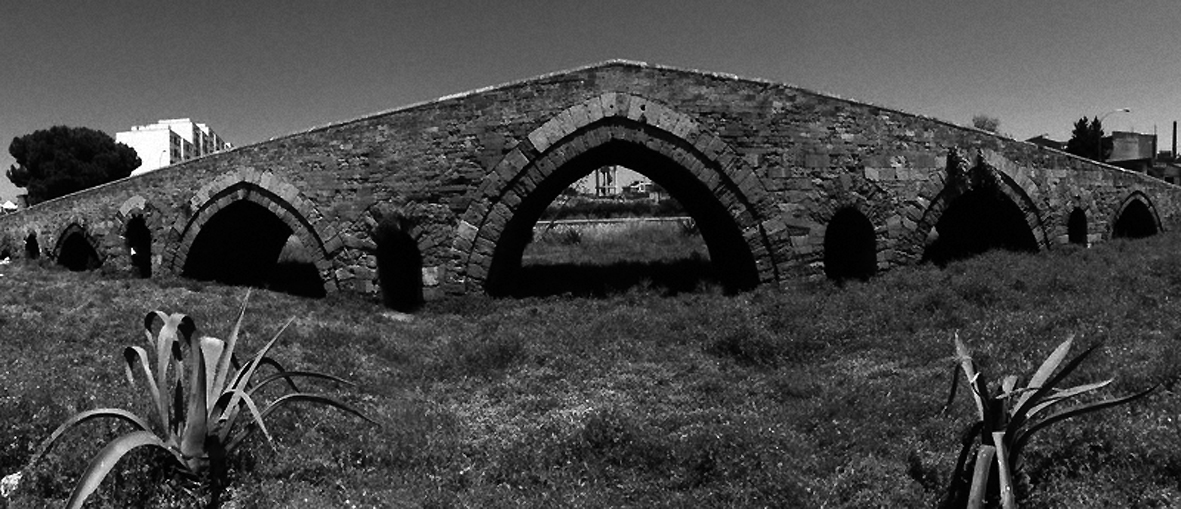
Ponte dell'Ammiraglio, Palermo c.1141

Continuing along the Via Maqueda takes you back towards the train station, but before leaving for Cefalu I skirted north-eastwards along the Corso dei Mille to a perfectly formed Norman-Arab bridge built by the same George of Antioch in 1140 to cross the river Oreto but now sitting high-and-dry in a park dedicated to Garibaldi. 

I sat there for a while and thought of George and Roger II and what they had achieved. 

It was Roger II’s grandson Frederick II (crowned King of Sicily at the age of 3 in 1197, and Holy Roman Emperor in 1220) who as another extraordinary precocious medieval intellectual was called Stupor Mundi or Wonder of the World by contemporaries. But he stood on the shoulders of his grandfather for whom that epithet should have been reserved. For all his achievements Roger II of Sicily was always considered by imperial northerners to be no more than a first generation robber-baron, a crusader against fellow Christians who had carved out a kingdom for himself by force of arms and manipulation of the papacy. This is true but in contrast to many other such men it was what he then did next with that Kingdom that made it almost a utopian ideal, the nowhere and everywhere of the world. 

The anniversary of Roger II’s death is on the 26 February.

Tomb of Roger II of Sicily, Palermo Cathedral

Tuesday, January 15, 2013

REVOLUTION AND FAILURE: THE MARTYRDOM OF EQUALITY


"Society is, indeed, a contract… Each contract of each particular state is but a clause in the great primeval contract of eternal society, linking the lower with the higher natures, connecting the visible and invisible world, according to a fixed compact sanctioned by the inviolable oath which holds all physical and all moral natures each in their appointed place."
The Works of the Right Honourable Edmund Burke. Vol III. John C. Nimmo, London 1887

Edmund Burke, the Irish-born statesman, political theorist and philosopher wrote these lines in a monograph entitled Reflections on the Revolution in France in November 1789 but which he delayed publishing until November 1790. The monograph decries the violence and conduct of the revolution in France, by advocating the necessity of a constitutional monarchy, but at its heart was an examination of the nature of revolution as a means to effect change in society. The pamphlet was to provoke responses by Mary Wollstonecraft with her Vindication of the Rights of Men in late November 1790 and Thomas Paine’s Rights of Man of March 1791 and Feb 1792.

One of the most fundamental acknowledged rights of mankind is, as detailed in Article 1 of the Universal Declaration of the Rights of Man: All human beings are born free and equal in dignity and rights. 

Equality is seen as the cornerstone of all society.

Perversely all revolutions that have occurred in history to change what could be classed as Burke’s societal ‘contract’ for that particular society have stressed the absolute equality of all participants in that revolutionary process. And yet in the accomplishment of that revolution the very seeds of its failure are sown.

Almost immediately, and one does not have to look back in distant history to recognize this pattern but only to analyse the very recent revolutions in Tunisia, Libya and Egypt, where a post-revolutionary hierarchy of participation is engendered all with an enormous sense of entitlement, and as a consequence a demand for a moral and legal tiering of that entitlement within the new society.

Montesquieu (Charles-Louis de Secondat, baron de La Brede et de Montesquieu d.1755); one of the lights of the Enlightenment whose work influenced both the French and American Revolutions, wrote in his 1734 study on the fall of Byzantium,  Considérations sur les causes de la grandeur des Romains et leur décadence that,

"Revolutions created more revolutions, so that the effect became the cause."

I remember when travelling in Iran a number of years ago talking to disaffected Iranians who decried the preferential treatment given to the families of Martyrs of the Islamic Revolution for access to education and health services through the Bonyad Shahid va Omur-e Janbazan, or Foundation of Martyrs and Veterans Affairs which also incorporates the Bonyad Shahid va Isaar-Garaan (Foundation of Martyrs and Affairs of Self-Sacrificers). 

Martyrdom is a very important aspect of revolutionary change in Islamic society and it is propagated particularly in Iran. Within the Iranian Constitution Preamble a figure of 60,000 martyrs is enshrined as the Price The Nation Paid in the Constitution to achieve the revolution over the Shah yet the most up-to-date estimate of the actual numbers of those killed in pursuit of the revolutionary change to be about 3200. There were however up to 1,000,000 dead and wounded as a result of the disastrous Iran-Iraq War of 1980-88 whose dependents are also catered by the Bonyad Shahid, including the families of the teenage Baseeji youths who walked onto minefields in order to clear them knowing they would be 'martyred' in the process. 

This veneration has perpetuated the ‘mill-stone’ of subsequent unequal entitlement that has occurred and the enormous emotive and economic power delegated to the Bonyad of Martyrs (the Foundation controls nearly 100 commercial companies) is creating the seeds of discontent, which will surely result in yet another revolution; it is only a matter of time, the effect will become the cause.

But the commemoration of revolutionary 'martyrdom' is not just an Islamic tradition. Ireland remembers the leaders of the 1916 Easter Rising (Revolution) who were 'martyred' for the cause and indeed every year I receive my family's invitation to the commemoration ceremony on account of the fact that my grandfather was a member of the General Post Office volunteers and also was involved in the landing of the guns from the Asgard. This attachment to remembering revolutionary sacrifice does not however come with economic or health benefits nor do I ever sense a personal advancement because of that association. America is no different. They remember their Revolution with the Founding Fathers, and the still extant organisations such as the Sons and Daughters of the Revolution. Even the very terminology implies an almost patriarchal hierarchy of social stratification following the revolutionary change.


In revolution and also in democratic change, Edmund Burke’s contention that there is an “inviolable oath which holds all physical and all moral natures each in their appointed place” anticipates that in any societal contract true equality can never be achieved, and as a society we either should stop looking for it, or accept it purely as aspirational. 

This is a bitter truth. As an individual member of society, acceptance of the status-quo, either the old or the new, grates, and you do what you can to perpetuate equality and on that basis all our ‘rights’. When frustration with inequality moves beyond self, beyond family, beyond clan and is cloaked in a communal desire reaction then revolution occurs. And yet like magma cooling, the force is spent and a base human desire for acknowledgement of sacrifices made overwhelm, and recompense demanded, even if that means denial to someone else who has not achieved the same ‘notional’ level of sacrifice in the service of the revolution.

To exist is not to be equal, revolution is not realignment, and the only true equality in existence is its end.


Carving from Persepolis, Iran (c.480 BCE)

Sunday, December 30, 2012

HAPPY NEW YEAR 2013

Christmas Day Swim 2012
Blackrock, Salthill, Galway

As always the New Year is a step into the unknown even if the landscape 
seems unchanged, seems familiar. 

Is not that the frisson of existence?

Have a happy New Year and an fulfilling 2013. 

Monday, December 17, 2012

Rihla (Journey 33): ADARE MANOR, LIMERICK, IRELAND: MISTLETOE, MARISCO AND MAGIC


Rihla (The Journey) – was the short title of a 14th Century (1355 CE) book written in Fez by the Islamic legal scholar Ibn Jazayy al-Kalbi of Granada who recorded and then transcribed the dictated travelogue of the Tangerian, Ibn Battuta. The book’s full title was A Gift to Those who Contemplate the Wonders of Cities and the Marvels of Travelling and somehow the title of Ibn Jazayy's book captures the ethos of many of the city and country journeys I have been lucky to take in past years.

This rihla is about ADARE, Co. Limerick, Ireland.

Adare village in Co. Limerick, Ireland, is a vibrant, surviving urban phenomenon of an otherwise Famine-blighted, fogbound, stone-rot landscape of Ireland of the 1840s with its wide boulevards, well built houses, pointed walls, cared-for thatch, generous public spaces, muted providence, an august trinity of friaries, and the brash haughtiness of a true manorial town that once serviced the needs of Adare Manor (commissioned in 1832 by Windham Henry Quin, the 2nd Earl of Dunraven and Mount-Earl with the spirited encouragement of his wife Caroline and finished by his son Edwin Wyndham-Quin, the 3rd Earl in 1862 in the midst of a social and economic disaster that existed elsewhere) but is now almost smug in its continuing exuberance that has seen it regularly voted as Ireland’s most beautiful town.


The Quins of Adare were the hereditary chiefs of the Hy Ifearnan (Heffernan) clan, of the Cineal Fearmaic sept of the Dál gCais kingdom of Munster (c.1000CE), and were originally from Muintir Ifernain in central County Clare (the later barony of Inchiquin). Windham Quin’s father Valentine, one of the last titular Gaelic tribal chiefs elevated to a peerage, was made an Earl in February 1822.

But Adare is much older a place than the Quin’s manor and its original Irish name was Áth Dara meaning the Ford of the Oak and this brings me to the connection to mistletoe. In the small, walled orchard garden of Adare Manor that now serves as the practice putting green for the championship golf course there are 5 or 6 apple trees that produce a really succulent fruit. But it is in December, when the apple fruit and foliage has withered away that the trees are at their most majestic. For it is then that they are covered in most wonderful green and white berry medley (like hollies only the female mistletoe has berries) that is the mystical and magical mistletoe. There are few, if any, places in Ireland that you can see, never mind touch, the plant in all its glory.

Adare Manor Garden Orchard Mistletoe

Mistletoe, a hemi-parasite plant that is transferred as a sticky seed excrement by the Mistle Thrush from deciduous trees (oak, apple sometimes lime) to tree, is not a native Irish plant yet does have an ancient Irish name: drualas. This is a derivation of Druidh las, the Druid’s herb. Very little is written down concerning the Druids but Pliny the Elder in his Naturalis Historie (c79CE) states,

 "The Druids (so they call their Magi) hold nothing in such sacred respect as the mistletoe, and the tree upon which it grows, provided it be an oak. 'Omnia sanantem appellantes suo vocabulo.' (They call it by a word signifying in their own language All-Heal.) And having prepared sacrifices, and feast under the tree, they bring up two white bulls, whose horns are then first bound; the priest, in a white robe, ascends the tree, and cuts it off with a golden knife; it is received in a white sheet. Then, and not till then, they sacrifice the victims, praying that God would render His gift prosperous to those on whom He had bestowed it. When mistletoe is given as a potion, they are of opinion that it can remove animal barrenness, and that it is a remedy against all poisons."

Beyond the pale of the manor Adare’s medieval ecclesiastical history is still visible with the presence of three Abbeys: Augustinian, Trinitarian and Franciscan.

Mosaic from 1218 above door of Trinitarian Church of 
San Tommaso in Formis in Rome.

The Trinitarian establishment (now the Roman Catholic Parish church) for me holds the most fascination, as the Trinitarian Order of Friars, who dedicated their lives to raising ransom money to redeem Christian captives on the Barbary Coast (as well as running hospitals in the slave banos of Algiers and Tunis), featured strongly in my first novel, The Simurgh and the Nightingale about Barbary Pirates in the 1600s. The Trinitarian Order, founded by St. John de Matha, was approved of by a Bull of Pope Innocent III, Operante divine dispositionis clementia, issued on the 17th December 1198. Other early Christian captive redemptionist orders were the Spanish Military Order of Santiago (1175), The Order of Montegaudio (1178), and the Order of the Merced (1218).  

The Adare abbey was the only Trinitarian establishment in Ireland and they had been invited there around 1229 by a second-wave archtypical Anglo-Norman robber-baron Geoffrey de Marisco. Geoffrey’s full name was Geoffroi de Montmorency de Marisco, Lord of Thorney and Huntspill in Somerset (Marisco being a derivation of Marsh). Geoffrey was well connected to Ireland as his sister had married Thomas Fitzmaurice Fitzgerald the founder of the House of Desmond. He became the Justicar or Lord Chief Justice of Ireland from 1226-28 and in addition to his connections also inherited extensive lands in Ireland from his uncle-in-law John Comyn, Archbishop of Dublin in 1192. He subsequently expanded his holdings by marrying as his second wife, Eve de Bermingham, the daughter and heir of Robert de Bermingham, Baron of Offaly.

In addition to the Trinitarian Abbey Geoffrey also invited the Knights Hospitaller to establish a commandery in 1215 in nearby Aney (now Hospital). The advantage of settling military and religious orders by the Norman barons on their properties was not entirely pious but guaranteed that associated (and tithe paying) lands would be held safe and their value increased. Geoffrey was to take part in many Norman attacks on the Irish in Connacht. This too was to leave a legacy as the Morris family, one of the famous Tribes of Galway, owe their descent to him.

It was not to end well for Geoffrey however. In 1238 an attempt was made to assassinate Henry III of England and suspicion fell on William (Geoffrey’s son– executed by being drawn, hung and quartered in 1242 for piracy and murder) and Geoffrey. Some time between then and 1242 he fled to Scotland where he was sheltered by a kinsman, Walter Comyn. In 1244 he was forced to leave Scotland, possibly as part of the agreement reached in that year between Henry III and Alexander II and he died in France in the following year.

Mathew Paris in Vol iii of his Chronica Majora of 1250 (with a side drawing of the execution of William) said unlovingly of Geoffrey that he was,

"a man who formerly been a noble and not least amongst the magnates of Ireland, who had incurred an indelible stain by the treacherous murder of Richard Earl Marshal, and who was now an exile, a wretched and hunted man, having been expelled from Scotland deported from England, and disinherited in Ireland, after the ignominious death of his son and the loss of all his friends, banished from public view, finally ended so many deaths with his own. (Obit Galfridus de Marisco, exul, pauper et profugus).”

Mathew Paris self-portrait

As you turn your back on Geoffrey’s Trinitarian edifice and walk back up the street and through the imposing gates of Adare Manor, you stare up at the oaks, and think of druids and ritual, pagans and sinners, slaves and free, normans and celts, exile and homecoming, and the perpetual timeline of change.


Adare Manor Mistletoe (7th December 2012)

And yet at the end of your journey, in a quiet walled-garden, you stand and wonder at the exuberance, the magic and mystery, and timelessness of mistletoe. That alone will always bring me back.


Druids cutting mistletoe with a golden sickle from an oak.