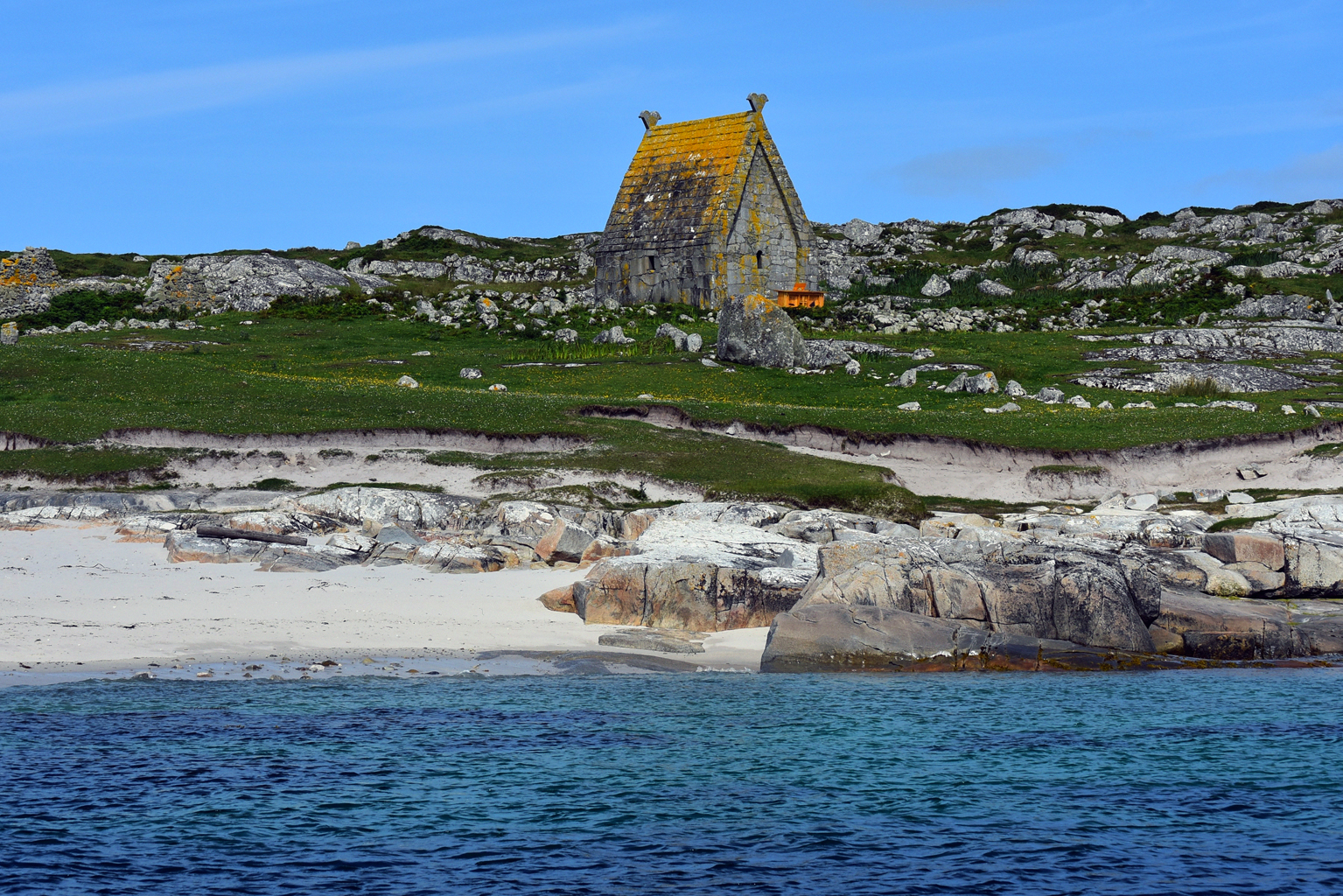
MacDara's Island
©www.jimfitzpatrick.com
Rihla (The Journey) – was the
short title of a 14th Century (1355 CE) book written in Fez by the Islamic
legal scholar Ibn Jazayy al-Kalbi of Granada who recorded and then transcribed
the dictated travelogue of the Tangerian, Ibn Battuta. The book’s full title
was A Gift to Those who Contemplate the
Wonders of Cities and the Marvels of Travelling and somehow the title of
Ibn Jazayy's book captures the ethos of many of the city and country journeys I
have been lucky to take in past years.
Some of the best journeys you can take are those
closest to you. This Rihla is about the island hermitage of St Sionnach MacDara
(on the island od Cruach na Cara a.k.a. Cruach Mhic Dara or Oileán Mhic Dara),
the patron saint of Connemara fishermen, that is located off the south-west
coast of Connemara near Mace Head and the annual fishermen’s pilgrimage to the
island held on the 16th July every year.


Little is known about the
life of St. Sionnach MacDara and yet he is venerated in a very significant way
on Iorras Aithneach (Iar Ros Ainbthech – Western Promontory
of the Storms), the Carna Peninsula in south Connemara. His ecclesiastical
feast day is listed in O’Hanlon’s Lives of the Irish Saints as being on
September 28 and yet Connemara fishermen also perform an intensely secular patrún or pattern in his honour on their
turas or pilgrimage to the island on
the 16th July every year, weather permitting. In addition to the Oratory church on the island there is a church dedicated to him in Moyrus and also a Holy Well.
Not bad for an almost
unknown saint.
Tradition associated with St Mac Dara meant that any fishing boat passing through the sound between Masson Island and MacDara had to lower their sails three times (modern boats with outboard motors still cut their motors in respect of the tradition) otherwise bad luck would hit them.
His given or forename Sionnach means fox, but Tim Robinson in his
book, Connemara – A Little Gaelic Kingdom feels it should be Síonach which means a storm or stormy
weather, and very appropriate as MacDara is one of the two saints associated with the Iorras Aithneach (of the storms) peninsula.
What is most likely is
that Sionnach MacDara was a monk or cenobite
in one of the early or mid-6th century St Enda’s, St Brecan’s or St Ciaran’s
monasteries on Inishmore of the Aran islands. St Enda is considered the father
of Irish monasticism and his foundations followed the asceticism of the
Egyptian “desert Fathers”, living in community but with a life dictated by
manual labour, study and prayer. St Ciarán Mac an tSaeir (of Clonmacnoise fame)
is the other major saint associated with the Conmaicne Mara tribal area of
Ioras Aithneach and perhaps this points to MacDara being a cenobite in his
Inishmore monastery and they may have left the Aran islands around the same time, circa
541 CE, with MacDara heading to establish his “hermitage” island off Mace Head and Ciarán
joining Senan on Scattery Island at the mouth of the Shannon before moving inland and founding Clonmacnoise.
Landing at Aill na hIomlachta
(The Rock of the Ferrying)
Looking East South East
The 6th century
saw the rise of the Irish “island hermit” tradition, such as that seen separate
to the main complex on Skellig Michael (see Rihla 63) on the south peak; on Church Island near
Valentia, Co Kerry; on Inismurray in Co. Sligo; or on High Island off NW Connemara
where cenobites wanting to remove themselves from the community moved to almost
inaccessible islands to become “Green Martyrs” (as distinct from Red Martyrs
who were killed for the “cause” – very few instances in early Christian or
pre-Viking 9th C Ireland) . The difficulty is often that these type
of ascetic hermits then attract a community to themselves hoping to
partake in the holiness and this is what appears to have happened on St
MacDara’s Island.


The oratory, which is a
corbelled stone roofed rectangular church was beautifully restored by the OPW
in the 1970’s, a restoration first mooted by R.A. Macalister in a paper
presented to the Royal Society of Antiquaries of Ireland in 1895, following his
visit to the island, “A very little outlay would put the whole structure in
sound state, and doubtless, preserve it for another 1200 years.”

Of note Macalister in his
visit, found lying face down one of the carved finials that previously had been attached to the apex of the east
gable end. The native fishermen of the 1800s considered the carved head in the
centre of the stone to be that of St. MacDara himself. This finial (and
presumably the other at the western end) subsequently went missing and was
nowhere to be found when the OPW went about restoring the Oratory. There is
some difficulty in accurately dating the church with some authorities believing
that originally the roof was a wooden construct and that sometime later,
perhaps after the main Viking incursions had settled down, the roof was remade
of more weather resistant (and available) stone. What is important is that
“mouse-ear” carved finials were a feature of early Christian monastic
gable-ends as depicted in the Temptation of Christ in the late 8th C
Book of Kells.


The carved finials as depicted in the Book of Kells. Finials are decorative carvings or pediments placed at the apex of towers (like a cross on a church bell tower or a crescent moon on a mosque minaret), or on the gable end apexes.
The carved gable-end
finials were also a feature of some early “chapel-like” reliquaries such as the
Monymusk casket of St Columba and indeed the gable struts of early 3rd or 4th century BCE Germanic North Sea wooden longhouses may have influenced the design as well as being the direct forerunner of the wooden gable-end cross-beamed curved apexes of the Scandinavian longhouses. What is not in dispute is that the replacement
finials commissioned by the OPW are very fine carvings and are weathering very well.

I went to the island on
the 16th July this year, landing with the first boat of the day. The
festival is now called Féile Mhic Dara and this year I reckoned about 1200-1500
people made it to the island and with the marketing of the Wild Atlantic Way
being such a success the numbers are only going to get bigger and I suspect
that at some point the traditional and “good-humoured” free ferrying of
pilgrims to the island by local fishermen (remember to bring your own, or borrowed,
lifejacket flotation device – not mandatory but important) will come under
pressure.

Unfortunately I was on
call and had to head back to the mainland just before the mass began and I was
unable to observer how many people still might have maintained the ancient
tradition of a seven times circumambulation of the chapel and the placing of
seven pebbles on the altar. I had hoped to see this done, and perhaps ask a
participant why he or she still did it. As a custom it would echo the penitent tawaf circumambulation of the Kaba in
Mecca, (and perhaps also the Stoning of the Devil) and be an echo of the
Middle-Eastern tradition of Early Christian monastic communities that gave rise
to the stylites of Syria and the island hermits of the west coast of Ireland such
as Sionnach MacDara.


Even
without this oblique association between the patrúns of East and West I found the geography, the historical
context, the convergence of the Galway Bay hookers at the small harbour, the
gathering of fishermen’s families from all over Connemara speaking Irish, the
gathering of the sky and sea on an ancient landscape, the acceptance of tourist
pilgrims, and finally the architecture of the conversation between mankind and
God absolutely fascinating, all of them speaking to a distant time and place…
in the now.