
Wednesday, March 30, 2016


Wednesday, March 02, 2016
RIHLA (Journey 57): THE QUAYS TO CONNEMARA – PART 6: CASHEL, ROUNDSTONE AND CLOONILE BAYS – GIANTS AND MOTHER-GODDESSES ROAMING
Rihla (The Journey) – was the
short title of a 14th Century (1355 CE) book written in Fez by the Islamic
legal scholar Ibn Jazayy al-Kalbi of Granada who recorded and then transcribed
the dictated travelogue of the Tangerian, Ibn Battuta. The book’s full title
was A Gift to Those who Contemplate the
Wonders of Cities and the Marvels of Travelling and somehow the title of
Ibn Jazayy's book captures the ethos of many of the city and country journeys I
have been lucky to take in past years.

Quays of Connemara - Part VI

The
whole landscape a manuscript
We had
lost the skill to read
A part
of our past disinherited:
But
fumbled, like a blind man
Along
the fingertips of instinct
John
Montague
A Lost
Tradition – The Rough Field
Dolmen
Press 1972

Roundstone Harbour
I remember reading –
deliberately seeking out – Montague’s poem following a visit to
the astonishing Neolithic urban complex at Çatalhöyük (c.8000 BCE) near Konya and the earlier temple complex at Göbekli Tepe (c.9,000 BCE),
northeast of Sanliurfa (Edessa) in Turkey in April 2012; elaborate, organised societal constructs that had been in existence for millennia and were already being abandoned before even the first peoples crossed over to a post-glacial Ireland.
In Turkish Göbekli Tepe means “Potbelly Hill”, and Çatalhöyük means "Forked Mound" descriptive toponyms (or for the purists, oronyms) of the appearance of the landscape on which the complexes are found. Being a romantic traveller “Potbelly Hill” or "Forked Mound" did not – despite a well-grounded understanding of the Turkish way of calling it like they see it – quite do it for me. Surely the extraordinary legacy of these sites should have had a more descriptive memory? But then I realised, as Montague had implied, parts of our past become ‘disinherited’, eroded more by language than perhaps by time. In Göbekli’s and Çatalhöyük's case Hattian, Assyrian, Hittite, Persian, Greek, Roman, Byzantine, Arab and Turk conquest had ensured this erasure of pre-historic topographic memory.


In Turkish Göbekli Tepe means “Potbelly Hill”, and Çatalhöyük means "Forked Mound" descriptive toponyms (or for the purists, oronyms) of the appearance of the landscape on which the complexes are found. Being a romantic traveller “Potbelly Hill” or "Forked Mound" did not – despite a well-grounded understanding of the Turkish way of calling it like they see it – quite do it for me. Surely the extraordinary legacy of these sites should have had a more descriptive memory? But then I realised, as Montague had implied, parts of our past become ‘disinherited’, eroded more by language than perhaps by time. In Göbekli’s and Çatalhöyük's case Hattian, Assyrian, Hittite, Persian, Greek, Roman, Byzantine, Arab and Turk conquest had ensured this erasure of pre-historic topographic memory.

Gobekli Tepe Turkey
Temple Complex c. 9000 BCE
(April 2012)

Çatalhöyük Excavations
(April 2012)


The Goddess of Çatalhöyük (replica)
(c.8000 BCE)
Yet, by way of solace, I also realised that all was not lost is this descriptive disinheritance, at least where pre-historical memories were concerned. In Ireland’s case,
ensured by isolation and the later Bronze Age arrival of Celtic races whose language
and storytelling embraced what had gone before, the pre-history was preserved in
the landscape, a memory of a time when giants and mother-goddesses could shape
both that landscape and human destiny.

The Quays of Roundstone, Cloonile and Cashel Bays
The R341 and R342 roads
that link Roundstone and Cashel in Connemara, with a junction at Toombeola
Bridge, define a sociological tidal zone: a transition between the ancient, feral,
scavenging, small-holding, climín (climín
feamainne – seaweed bales) gathering, Irish-speaking south and south-western
parts of Connemara and the semi-planted, Victorian, English-speaking western
and north-western parts. It is a very particular landscape where the croísin seaweed
gathering poles have been laid down in favour of the theodolite.

Derryadd West Pier
The distance between
Roundstone and Cashel is only 13.5km and takes by car about twenty minutes. Yet
in that journey you not only cross over a land distinguished by a change in
language and attitude but also one that retains the lore of mythological giants
and mother goddesses who shaped and named the land before ever a Celtic
cattle-raid was made. This is all the more apparent if you hesitate on
that journey and stand for a moment on Toombeola Bridge, the “sacred centre” of
this particular journey.

Location of Bencullagh, Toombeola and Aillenacally
On one bitter-cold mid-January
day that I was there a snowfall of the previous evening, like a sprinkling of
icing sugar, separated the grey granite of the low mountains from the even
lower grey sky. Beneath me the salmon-filled Owenmore River cascaded to the sea
from Ballynahinch Lake and to the north rose the Twelve Pins, the mountains of
Connemara that are called in Irish Na Beanna Beola, the bens or peaks of Beola.

Scrahallia Quay

Cashel-Zetland Quay
Beola, was a chieftain of
the Fomorian race, the supernatural race of people who the Celts presumed had preceded them, a
mythological giant of a post-glacial era who had shaped the mountains to his
will. His burial site was supposed to be at nearby Tuaim Beola or Toombeola, where
a cairn of stones marking the spot had been robbed to build an abbey in 1427, which
then also become ruined; those same cairn stones being moved again to build a
small O’Flaherty castle on an island in Ballynahinch lake.


Canower Quay
To the north of the
bridge, beyond Ben Lettery, which overlooks Ballynahinch lake, is Ben Cullagh
or An Chailleach, the Hag, named after the mythological mother of Beola. Her association
with this area does not end there for south of the bridge there is a small,
peninsular townland that links those mountains to the sea, links Beola to his
mother, and which is called Aillenacally or Aill na Caillí, the Cliff of the
Hag.


Looking directly north along the river that drains Toombeola Lake
into the sea at Aill na Callí (Aillenacally).The first mountain to
left of centre is Bencullagh or An Chailleach (The Hag)
with its denuded quartzite scree exposed slopes.
The Caillí or more
commonly the Cailleach Bhéarra, or Hag of Beara, is one of the most persistent folkloric
memories of a mythological mother goddess, an Indo-European crone whose name is
retained on the coastlines from the north of Scotland to the south-western tip
of Ireland.


The Cailleach Bhéarra was, in our modern interpretation of the past, an inheritor of the Paleolithic (c.27,000 BCE) Venus of Willendorf, or the seated Goddess of Çatalhöyük (c.8000 BCE): the fecund goddess of winter, the earth-mother who could create and shape landscapes and individual rocks and who was also responsible for the winds and tides of destruction. In an early pagan Gnostic interpretation of the forces of good and evil that shape our human world the Cailleach represented the dark side and as such she demanded appeasement and was a primary target for eradication when the Christian missionaries landed on our shores.

An Cailleach Bhéarra Rock
Beara Peninsula West Cork

Venus of Willendorf
(c.28,000 BCE)
The Cailleach Bhéarra was, in our modern interpretation of the past, an inheritor of the Paleolithic (c.27,000 BCE) Venus of Willendorf, or the seated Goddess of Çatalhöyük (c.8000 BCE): the fecund goddess of winter, the earth-mother who could create and shape landscapes and individual rocks and who was also responsible for the winds and tides of destruction. In an early pagan Gnostic interpretation of the forces of good and evil that shape our human world the Cailleach represented the dark side and as such she demanded appeasement and was a primary target for eradication when the Christian missionaries landed on our shores.

Wallace's Quay Lettercamus

Cuan na Loinge (Ship Harbour) Lettercamus
And yet she persisted in
both memory and in the landscape. The Hag of Beara rock, a whitewashed pillar
decorated with votive coins and bric-a-brac ( appealing in the main to the fertility prowess of the Hag, a form of In-Petrous Fertilisation you might say!), near Eyeries on the northern coast
of the Beara peninsula is probably the most venerated of her old veneration
sites, and a tangible link with our pre-historic past. Nearby Dursey Island, in Irish Oileán Baoi is named after the Cailleach Bhéarra and she is thought to have her final resting place in the townland of Baile na Cailleach on the Island.

The bogland between Aill na Callí and Toombeola
Aillenacally – Aill na Caillí – Village and
Quays:
The Wrath of the Cailleach
Summer
of youth in which we were,
I have
spent with its autumn,
Winter
of age drowns everybody,
Its
harvest has come to me.
Stanza
19
Caillech
Bérri
(Old
Irish poem written c.900 CE)
The village of
Aillenacally – Aill na Callí – on the south eastern shore of the small
peninsula has succumbed to the wrath of the Cailleach. Abandoned by the last
villager Peter Ward, who had lived without neighbours for nearly 12 years, in
1995 it comprises of about 14 roofless, thick-walled cottages and
outbuildings that tumble down to the sea. It is reached by traversing a narrow
road that first dips and then rises across a boggy flatland.
On reaching the village it
is hard not, when looking back, to think of Peadar O’Donnell’s 1929 novel Adrigoole,
and the reasons for villages like his fictional village right along the western seaboard being
lost in time and place to economic emigration. The landscape is the
protagonist. This is where the bog is sinister, or as O’Donnell writes,
“subjugating” its inhabitants; where,
“Only low-lifed things could live in there; fat,
bulbous lazy frogs that come out of soft,lifeless, spongy spawn, and go out
again in slimy, clammy death.”

Ward's Harbour Aill na Caillí
Below the last rise out of the bog there are two old harbours
with crumbling walls, one of which is protected by a
slim, 19th century sea-wall that stretches now without purpose into
Cloonile Bay.
In the early 1990s a man
called Paddy Power bought up the whole village and 65 acres of land and began
to market the ruined village as the oldest village in Ireland. After court
fights with his neighbours over access to commonage, and with his solicitors
over difficulties in registering titles, Power sold the village to an anonymous
buyer in 2008. One house in the village, Peter Ward’s, has been restored as
holiday home but the remainder remain derelict. (Turtle Bunbury writes movingly
of encounters with the last villagers Tony Ward and Mikey Conneely and I
reference the link below).

The Donkeys of Aill na Caillí
The first harbour you encounter as you climb a gate
and follow a donkey path is Ward’s Harbour, its low walls crumbling back into
the sea.


O'Donnell's Quay Aill na Caillí
In the once main harbour a
short distance westwards a dilapidated blue-hulled hulk of a schooner called
the Manissa of Cork, lies forlorn, like tidal flotsam trapped within the
crumbling walls of the old quayside, just about protected from the sea’s
complete destruction by the slim 1820s breakwater. Paddy Power and his daughter
had used the schooner as their home when he owned the village and the battered
hulk was included in the 2008 sale. At
the neck of the breakwater is the ruin of a house that used belong to a Stephen
O’Donnell.

O'Donnell's House Aillenacally

In Peadar O'Donnell’s later 1933
drama Wrack he intones an ancient history and the memory of the destructive winter gales of the fecund storm goddess Cailleach Bhéarra, bringing both pleasure and pain to mankind, when he has his character Fanny Brien lament,
“The thick thighs of the waves crushed the life out
of our men, for I saw it.”
In the case of Aill na
Caillí, the Cailleach, the Xenia Onatopp of mythology, the goddess of the winter storms has done just that: to
man and stone.

References:
Gobekli Tepe:
Aillenacally
– Aill na Caillí:
http://www.turtlebunbury.com/published/published_features/pub_feats_aileenacally.html
Friday, February 19, 2016
RIHLA (Journey 56): GALWAY WATERWAYS: ELECTRIFICATION AND ELECTROCUTION
Rihla (The Journey) – was the
short title of a 14th Century (1355 CE) book written in Fez by the Islamic
legal scholar Ibn Jazayy al-Kalbi of Granada who recorded and then transcribed
the dictated travelogue of the Tangerian, Ibn Battuta. The book’s full title
was A Gift to Those who Contemplate the
Wonders of Cities and the Marvels of Travelling and somehow the title of
Ibn Jazayy's book captures the ethos of many of the city and country journeys I
have been lucky to take in past years.
This Rihla is about the
waterways of Galway and in particular the location of those places that harnessed
the waterways for electricity.

Galway 1651 and today.
(Medieval town highlighted in sepia colour).
Orientated with East to top.
THE CORRIB DELTA AND HUMAN RIGHTS
The Nile delta is huge and has been an ever-changing labyrinth of escape
to the sea of that great river. Over the millennia whole distributaries have
shifted course or disappeared altogether resulting in once great communities
and their contributions to civilisation being lost along the way, silting
history and memory along with the watercourses. The Corrib river delta on the
other hand is small and its watercourses much more defined. To walk and examine
the entire system of waterways that surround Galway city at the mouth of the Corrib would take you a day at most. But that walk is worth it.

The Corrib Delta Waterways
OS Map 1895
The sand bars and shale islands of the Corrib delta were formed by ancient
eddies of time and water, and the distributaries that define them have long ago
been corralled in bricks and mortar by Norman empire builders, Elizabethan
planters and Victorian industrialists and are tangible. The creaking
lock-gates, fishermen’s jetties and rotting sluice gates that punctuate the
waterways all give a hint to their story and yet even within this
mini-labyrinth, even where the connection of land and water is set in stone,
history and memory still have a way of getting lost.

Location of hydroelectric schemes in 1890s and 1930s
A number of years ago I returned to university to pursue a Masters
degree in International Human Rights Law at the Irish Centre for Human Rights
(ICHR) on the National University of Ireland Galway campus. I chose for my
thesis a study of the 1987 UN Convention against Torture and other Cruel,
Inhuman or Degrading Treatment or Punishment and in particular the work of the
Special Rapporteurs. The ICHR is located in what was once a Fever Hospital directly
on a major distributary of the Corrib known as the Gaol River because it
flows behind (to the west) the Cathedral, which is built on land that was once
the site of the 19th Century City and County Gaols. The Gaol river
flowing downstream south from the Centre ends abruptly at the sluice gates of
the McLaughlin Building, a former flour mill that straddled the river but which
subsequently housed one of the two early sites for hydroelectric generation in
the city. It’s a walk I used take most evenings after lectures when returning
from the Centre to the corporation car park to the south of the Cathedral.

The NUIG McLaughlin Building on the Gaol River Galway.

Electricity and the electrification of Galway in the late 1800s became
an interesting extension to my work in the ICHR. As part of the background
research for the thesis I had cause to examine the decision-making that enabled
electrocution (the electric chair) become the capital punishment of choice in
the USA and how the decision on what type of electricity current to use became,
with the first execution undertaken by the method, a brutally cynical
manifestation of a commercial battle between two conglomerates, Edison and
Westinghouse for control of the nascent electrical power supply to the American
market.
THE COMMERCIALISATION OF CAPITAL PUNISHMENT – AC/DC WARS
Thomas Edison the inventor of the phonograph in 1877 formed the Edison
Electric Light Company the following year to commercialise his patent of a carbon-filament
incandescent light bulb. In 1880 he then formed the Edison Illuminating Company
as an electrical utility, which used 110 volt direct current (DC) for its power
supply. In 1884 he hired Nikola Telsa and asked him to redesign and improve
Edison’s DC generators. Telsa fulfilled the brief but was then short-changed by
Edison on the promised financial reward for doing so.
Telsa left the Edison company in 1885 and established in 1887 the Telsa
Electric Company to design an effective induction motor that would run on
alternating current (AC) instead. George
Westinghouse of Westinghouse Electric & Manufacturing Company bought the
licence for these motors and quickly began to promote the higher voltage AC as
the power supply of choice for electrification in the USA as it was becoming in
Europe. Thereafter developed the so called War of Currents between Edisons DC
and Westinghouse’s AC supply which ended in 1892 with AC winning out and Thomas
Edison losing control of his own company, which then became General Electric
using an AC generation platform. This was perhaps commercially inevitable as DC
did not transmit over long distances whereas AC could and also more cheaply as
the higher voltage used smaller copper wires. AC also had the ability to use
transformers to step up or down transmission voltage at the point of usage.
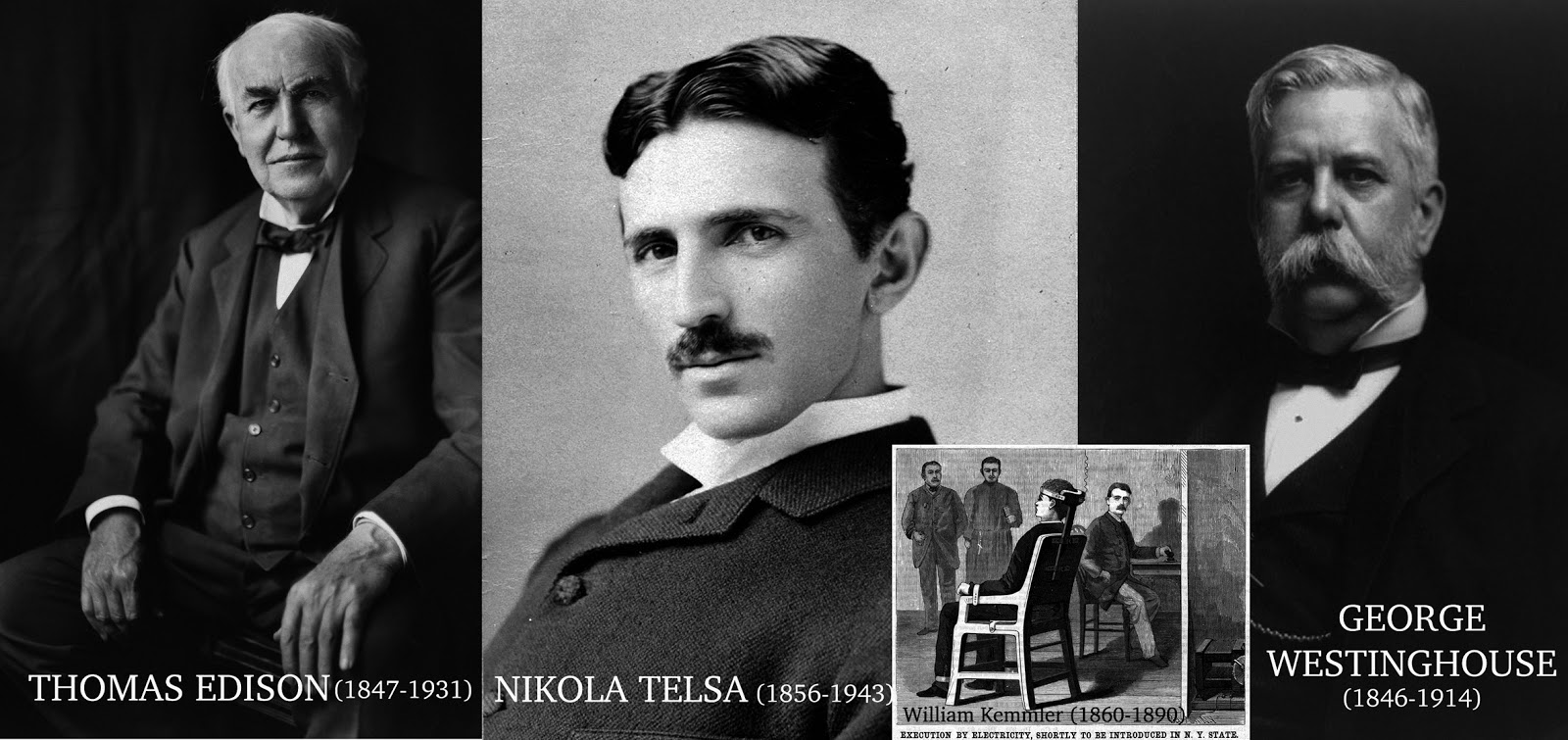
The three key personalities in the 'War of the Currents'
In the middle of this so-called war of currents perhaps one of the most
despicable and cynical confrontations between the two types of power supply and
the battle for commercial supremacy took place. Edison had always sincerely
believed that the AC transmission system of high voltage would lead to multiple
deaths. In 1886 following a series of botched executions by hanging the New
York governor appointed a commission to find a form of execution more humane
than hanging. The commission was chaired by Eldbridge T. Gerry and included a
dentist called Alfred P. Southwick. Southwick had already proposed electricity
as a form of execution as early as 1881 and he wrote as member of the committee
to Edison looking for support. Edison initially declined stating he was against
capital punishment but then acceded to the request and in December 1887 wrote
in support and deliberately stated that AC (rather than his own DC generators)
machines and particularly those manufactured by Westinghouse would do the best
job. This disingenuous support was to intended prove the “lethality” of the AC
system and thus would hopefully scare off customers.
The report of the commission was presented to the governor and a
legislative bill authorising execution by electricity was passed by the New
York legislature and signed off by the Governor David Hill on June 4, 1888 to
come into operation in January 1889. The bill did not specify what type of
current or at what voltage the electricity should be and these aspects were
delegated by the Commission to the Medico-Legal Society of New York. Edison
supplied the Society the services of his best engineer Arthur Kennelly and
facilities to ensure that AC would be the chosen current. Again this should not
have been in doubt as published papers in Europe from 1890 had already shown
the high resistance of human and animal flesh to DC application. Edison’s
involvement tipped the favour in his suggestion that AC should be used.
The Governor Hill then signed a bill in March 1889 authorising the
purchase of machinery to perform executions by the superintendent of prisons.
Westinghouse realised from early on what Edison was attempting to do with his
‘support’ for AC electrocutions and refused to sell any of his AC generators to
be installed in prisons. Edison appears to have funded a phoney company to
purchase these so that they could be installed.
On May 15, 1889 a man called William Kemmler a.k.a. John Hort, who had
battered his wife to death, was sentenced to be the first man to die by
electrocution according to the Code of Criminal Procedure of New York. His
sentence was appealed first to the County Court and then to the New York Supreme
Court as being a ‘cruel and unusual punishment’ and Edison was called to give
evidence; evidence which was shown up by a very famous defence attorney called W
Bourke Cockran to illustrate that Edison had little or no knowledge of human
anatomy or of the biological properties of electricity. Westinghouse had paid
for the very high fee-earning Cochran to present the defence in a last-ditch
attempt to prevent his AC system being used for executions and the association
of AC with “lethality”.
A final State appeal to the New York Court of Appeals was made in March
1890 and again was rejected. The case was then appealed to the US Supreme Court
in May 1890. The Supreme Court rejected the appeal but within its judgement
proposed a standard of ‘cruelty’ that was to remain in effect as ratio decidendi guidance for the next
100 years. The Court declared,
“Punishments are cruel
when they involve torture or a lingering death; but the punishment of death is
not cruel, within the meaning of that word as used in the Constitution. It
implies there is something inhuman and barbarous, something more than the mere
extinguishment of life.” (Kemmler 136 US at 447
1890)
Following rejection of the appeal to the US Supreme Court Kemmler went
‘to the chair’ on 6 August, 1890. There were 25 official witnesses including 14
physicians. The execution used 1700 volts. At 06.43 after seventeen seconds of
application the attending doctor Dr Spitzka pronounced that Kemmler was dead
and the Warden Dunston ordered the dynamo turned off. Then it was very obvious
that although unconscious Kemmler was breathing heavily. After some adjustment
of the head piece the current was turned on again and continued for 72 second
when the smell of burning flesh became evident. Edison claimed that the “botch”
was the result of mistakes made by the doctors involved. Westinghouse declared
they would have done “better with an axe.”
Kemmler had paid for the bitter commercial rivalry between Edison and
Westinghouse with a protracted, cruel and tortuous death. Despite many more
problems with further executions by electricity, including that of Charles E.
MacElvaine in February 1892, where Edison’s own proposals for application of
electrodes was used, and developing an
effective “chair” by 1971 23 US States had adopted electrocution as the desired
method of capital punishment.
GALWAY ELECTIFICATION – Gas v. Electricity Wars

Minutes of Galway Town Commissioners November 1888
On the 1 November, 1888 shortly after the New York ‘Electrocution’ Bill
had been signed into law, James Perry, an engineer and county surveyor of the
western district of Galway, applied on behalf of Galway Electric Company,
a private entity he had formed with his brother Prof John Perry of the Royal
College of Science in London to generate electricity, for permission from the
Galway Town Improvement Commissioners to ‘erect poles in some parts of the town
as an experiment for the electric
lighting of the Town.’ Proposed by the Major Wilson Lynch of the Galway Militia
and seconded by Sir Valentine Blake (14th Baronet) the proposal was
adopted. 1888 was the same year that Hertz had succeeded in detecting
electromagnetic waves.
The Galway Town Improvement Commissioners were established under the
1828 Act for the Improvement of Lighting in Towns. In 1841 the Board of the
Commissioners took over all of the local authority functions of the Galway
Corporation, which had been in existence since 1485, and which was abolished by
the Municipal Corporations (Ireland) Act of 1840. Lighting of the town was a
key feature of their deliberations and generally in the 1880s involved entering
into a rolling contract with the Galway Gas Company for the supply of the power and then designating
where the standard gas-lit Bray Lamps should be erected.

The mechanics and design of a Francis Turbine driven
hydroelectric system.
James Perry as an engineer and County Surveyor and his brother had recognised very early on that the rapid
developments in electricity generation and its application was going to
revolutionise both the lighting and industrial sectors. The 1882 Electric
Lighting Act introduced to legislate for the new companies bringing electricity to the market had been very prohibitive to those entrepreneurs establishing companies
as all investors were required to sell their assets back to local authorities after
21 years. An new Act of 1888 eased these restrictions and extended the buy-back time
period to 42 years and also required the Government to purchase the assets as a
‘fair-market’ value. Encouraged by this development the new Galway Electric Company
bought an old flour-mill, which had existed since the 1600s and which straddled the eastern conduit (Friars River) of the Corrib
river in the Newtownsmith part of the town in May 1888. They installed a
hydroelectric turbine in the watercourse which was then linked to a generator producing
alternating current.

Hardiman's redrawing of 1651 Pictorial Map of Galway showing
locations of Perry's and the University's hydroelectric stations,
both situated in old flour mills.
There is no documentation available as to the type of turbine and
generator the Galway Electric Company installed but most likely, given that it
was also adopted by the later University scheme, to have been a Francis Turbine
linked to an early Siemens or Ferranti AC generator. The company started off with a
private-scheme customer base of about 59 houses and this was the reason for their
application to the Commissioners for the erection of poles to deliver that
current to their customers. It immediately entered into competition with the
Galway Gas Company where public lighting was concerned and the first victory in
this battle was in March 1890 when Galway Electric Company were awarded the
contract by the Galway Harbour Commissioners to light the port and docks area
at a cost of £40 per annum. The minutes of the Galway Town Commissioners detail conflict over whether underground or overground delivery should be promoted and the disruption subsequently caused by both the gas and electricity companies digging up the streets.

The Fishmarket, Spanish Arch, Galway 1903.

Galway 1901
The picture shows both a gas street light (centre) and a recently installed
electrical light (right).

Galway's main street. c.1905
The lighting scheme did not appear that extensive with a single standard
light seen in middle of picture

Galway c.1905
Again a single lamp outside Lynch's Castle mid-way down
the main street.

Cork's Main Street c.1905
By way of contrast the electrification of Cork began in 1898 and was
undertaken by Cork Electric Tramways and Lighting Company a subsidiary
of British Thompson-Houston who in turn were a subsidiary of General Electric,
the former Edison Electric company, in the US. The electric lighting was closely approximated to the
tram tracks.
In 1896 the gas v. electricity 'war' was reaching its 'boiling-point'. Galway Electric Company in that year were granted a Provisional Order, sanctioned by
the Board of Trade, for the supply of electric light to the town of Galway
itself. This induced the Perry’s to incorporate the Company but before floating
it they asked the Town Commissioners to exclude the Salthill area from the
Order as it would prove an impediment, based on cost estimates, to a public
listing of the company. This request was acceded to by the Commissioners. By
September 1899 when the Galway Electric Company Ltd. submitted a detailed plan
and map for a new mains supply and although the installation work proceeded very slowly the battle between Galway Gas Company and the
Galway Electric Company Ltd. for the public lighting of Galway was as good as over.


The scheme was almost fully installed by 1906 but not to everyone's satisfaction!

Galway Town Commissioners Minute Book 1904.
Temporary contract with Gas Company and letter to James Perry urging
Galway Electric Company to get on with their work of installation.

Galway Town Commissioners Minute Book 1905.
Gas Company prevented from dismantling and taking away
their installations and Electric Company admonished about
the state of the roads due to their works.

Galway Town Commissioners (UDC) Minute Book 1907.
Admonishment of Electric Company's 'defective' lighting about the town.
The scheme was almost fully installed by 1906 but not to everyone's satisfaction!

The Eastern Conduit of the Corrib River now renamed
Friar's River.


The new shopping centre built on the site of the
Galway Electric Company's hydroelectric generating station.
In 1902 James Perry acknowledged the difficulties with a total reliance
on the Corrib water flow particularly given the demands of the fisheries and
other mill workings and the seasonal variations in the head of water entering
his turbines. To overcome these issues he had installed an auxiliary Welsh
anthracite-driven Dowson gas plant and a Crossley generator. He also had been using
battery storage and had installed his newest one in the Autumn of 1901. He was
vigorous in his defence of Galway Electric Company’s efforts when he stated,
‘As Irishmen we desire to see our island prosperous, and we know that if we can
present a hopeful scheme which will bear the criticism of men who are outside
the glamour of sentiment, we shall be able to get money and give the scheme a
fair trial.”

The Presbyterian Church on Nuns Island (now part of the Arts Centre)
where Alice Perry paid in 1968 for a plaque to be erected to the memory
of her parents.
James Perry died in November 1906 a month after seeing his daughter
Alice Perry obtain a First Class Honours degree in Civil Engineering, the first
female Engineering graduate of any University in the then British Isles. She
took over her father’s duties as County Surveyor until April 1907 when a ‘male’
replacement was chosen. In 1929, two years after the legislation establishing
the Electricity Supply Board was formalised, Galway Electric Company was
serving 1017 consumers in a city with a population of 14,000; it generated
745,290 units of electricity per year and sold 474,135 units at an average cost
of 4d per unit and employed 19 people. In May of that year Major Sam Perry,
James Perry’s son and Managing Director of Galway Electric Company announced
that because the supply of electricity would soon be taken over by the ESB the
company would not be investing in any further infrastructure or taking on any
new customers.

Notice by Galway Electric Company of a winding up of operations in 1930.
The ESB subsequently acquired the premises and shortly
afterwards the Galway Electric Company ceased to exist. In the following year
1930, perhaps in order to maintain an expertise in small scale hydroelectric
generation and perhaps as a homage to the Perry family and their connection
with the University, University College Galway engineering school installed a
Francis turbine manufactured by Craig & Son in Belfast and a generator in its
McLaughlin building on the Gaol River. In the 1980s a second plastic Francis
turbine was also installed on a separate watercourse.


The vertical Schorch generator which sits atop the drive shaft
ascending from the 1930s Francis turbine in the Gaol River
NUIG McLaughlin building.
POSTSCRIPT – DEATH BY ELECTROCUTION
To end this particular journey around the waterways of Galway on a more
poignant note I wanted to highlight, in the lost history of the waterways, a
strange twist of fate and a death by electrocution, by a connection between
Galway’s electrification by Galway Electric Company and Thomas Edison’s cynical
promotion of AC as the power-supply of choice for electrocution as a capital
punishment.
A Leopold W. Heath had been a student of Prof John Perry in London and
after graduation in 1892 Perry arranged for Heath to come and work in the family’s
Galway Electric Company. In 1900 after a few years back in England he returned briefly
as manager of the Galway Electric Company only to leave again in 1902 to work
for the General Electric company in Schenectady New York. General Electric was the
company formed by the 1892 merger of Edison General Electric and Thompson-Houston
Electric companies. On the 3 July, 1902 Leopold Heath died as a consequence of
being electrocuted by a defective switch in the company laboratory, perhaps the
same laboratory that Edison had leant in 1889 to the Medico-Legal Society
delegated by the New York Commission into a humane form of execution for them
to undertake their studies. It is not stated in his obituary whether it was an
AC or DC power supply that killed him!!

Old sluice gate that controlled the water flow into the
1930 turbine in the NUIG McLaughlin Building.
Looks very like a guillotine!!
Subscribe to:
Posts (Atom)