Tuesday, January 11, 2011

Rihla (Journey 19): Languedoc, France – Cathars, Torture and Catharsis


Catharsis!


Rihla (The Journey) – was the short title of a 14th Century (1355CE) book written in Fez by the Islamic legal scholar Ibn Jazayy al-Kalbi of Granada who recorded and then transcribed the dictated travelogue of the Tangerian Ibn Battuta. The book’s full title was A Gift to Those who Contemplate the Wonders of Cities and the Marvels of Travelling and somehow the title of Ibn Jazayy's book captures the ethos of many of the city and country journeys I have been lucky to take in past years.

This rihla is about the Cathar region in Languedoc, France.

Four years ago I returned to university to pursue a master’s degree (LLM) in International Human Rights Law, at the Irish Centre for Human Rights, in NUI, Galway on a part-time basis. The subject for my thesis was Torture and in particular the work of the Special Rapporteurs on Torture.

PH Koojimans, the first Rapporteur, stated in his initial 1986 report to the UN (UN Doc. E/CN.4/1986/15, para.4) that:

Torture is the violation par excellence of the physical and mental integrity in their indissoluble interdependence – of the individual human being.

Defined in its broadest sense torture is the intentional infliction of severe physical or psychological pain on another human being to the extent that the victim is dehumanised. Political or public torture, torture sub specie civitatis, either legislated for or sanctioned by the state and carried out or mandated by an agent or agents of the state (including the judiciary) has a long history.

In the classical Greek era rational scientific thought had helped evolve the notion of justice or dikaiosyné – after diké, the coercive enforceability of divine decrees – as a distinctly human, albeit abstract moral principle. In the early polis, or Greek city-states, individual virtue was directly linked to the common good and citizen and state were perceived as one. Torture, as part of the legislative process, was accepted as a necessary instrument for the protection of the individual and hence the collective. Its application, however, was highly selective. Slaves were not considered to have an individual moral worth and around the time that written testimony began to be used in courts, circa 380BCE., Aristotle included in his Rhetoric five sorts of documents that could be submitted for arbitration: laws, testimony of witnesses, contracts, basanoi and oaths.

Basanoi – derived from the Greek word for the tools that were used to determine the purity or “truth” of gold – were the permitted testimony obtained from slaves under torture concerning information demanded of their masters. Citizens could not be tortured and the basanos was generally reserved for the resolution of private disputes.

In Roman law, during the early Republic (circa 450BCE), freemen were never tortured and in keeping with Greek precedence Rome reserved quaestio only for slaves. In the beginning there were clear guidelines: slaves could only be tortured to prove the guilt of their own masters in cases of incestus – which was a crime against the gods – or where the senate made a specific judicial exception in some special instances. By 60BCE however political expediency determined that slaves could be tortured to bear witness against their masters in cases of majestas and by the time of the Emperors this authority was extended, in similar assaults on the state, to all freemen and citizens.


Medieval Torture

With the advent of Christianity some of the great early writers of the Church began to question the excesses of the application of judicial torture under Roman law. St. Augustine of Hippo in particular, writing around 420CE, was especially scathing of secular judges:

'What shall I say of torture applied to the accused himself? He is tortured to discover whether he is guilty, so that, though innocent, he suffers most undoubted punishment for crime that is still doubtful, not because it is proved that he committed it, but because it is not ascertained that he did not commit it. Thus the ignorance of the judge frequently involves an innocent person in suffering.'

Pope Gregory the Great confirmed this reasoning around 600 CE and to all intents and purposes, political torture in Europe ceased until the early middle ages.

This was to change again. In 1184 Pope Lucius III established Episcopal Inquisitions to counteract heresy in particular Catharism.


The Cathars were a dualist sect whose spiritual leaders or Perfects considered themselves the ‘Pure Ones’ or katharos, particularly when contrasted to the abuses conducted and condoned by the Catholic clerical establishment of the time. They best established themselves at all levels of society in the Languedoc region of France from about 1100CE causing enough consternation to have the Church send in their best preachers such as St Bernard of Clairvaux and St Dominic to try and counteract it. This approached failed and in 1208 Pope Innocent III launched the Albigensian crusade to rid the Languedoc region of the Cathar heretics.

In parallel to the military campaign although Innocent III had precluded torture the Episocopal Inquisitors were given more and more power and in 1231 Pope Gregory IX expanded their remit and formally established the Papal Inquisition as a professional, accountable institution dedicated to the eradication of heresy. The Inquisition’s control was placed in the hands of the Order of Preachers, the order established by St Dominic and later to be known as the Dominican Order, and they took to their work with so much relish that they were sometimes known as Domini canes, the Hounds of God.


Harmless 20th Century US Torture!

Sometime later, in uncomfortable parallels of today’s US sanctioning of water-boarding as a justifiable ‘form’ of legal torture, fundamentalist paranoia and imperial ambition, in a Papal decree that was going to determine the relationship between penitents and a punitive church for 400 years, Pope Innocent IV, in his Bull ad extirpanda of 1252, formally permitted the re-introduction of torture as a legal means of enforcing confession from supposed heretics.


This facilitation was to plant deep roots in most countries legal regimes and it was not until the 1740’s on mainland Europe that the influential writings of Montesquieu and Cesare Bonesana in particular, began the process that culminated in the 1984 UN Convention against Torture and Other Cruel, Inhuman or Degrading Treatment or Punishment (CAT).


The Cathar supression had always fascinated me, as my mother had been a lay member of the Dominican order, and while she was alive I had often teased her about the Order’s historical predilection for torture. In late September 2008 I had 10 days holiday available to me and decided on the spur of the moment to head for Cathar country, just to experience the geography and in particular some of the mountain-top fortresses where they took refuge before ultimate extinction at the hands of the crusading barons, as well as completing my thesis.


The Cathar ‘heresy’ suppression became essentially a side-show in powerful fight between Aragon, the Papacy and France for control of the resources and riches of the previously independent Languedoc region and as I climbed the heights of the castles of Peyrepertuse and Quéribus (the last significant Cathar refuge to fall in 1255) and looked out over the rich valleys and high hills towards the present-day Spanish border you could understand why.


Quéribus


The small villages passed on the way were very quiet, secretive almost and the walls of mountain guest-houses’ paper-thin. Nights were spent suppressing coughs and evil thoughts and waiting for the mating games to end. I tried not to think of one of the last of the ‘Perfects’ Guillaume Bélibaste in 1313 being discovered having sex with Raymonde by her sister Blanche. Sex for Prefects was an absolute no-no and indeed the eating of meat of any animal or fowl that indulged in any kind of sexual intercourse was prohibited. Blanche exclaimed on disturbing the couple’

‘Oh Madam-the-misbegotten-bitch, you have compromised the entire cause of our holy church.’


Auto de fe
Bélibaste was to die in an auto de fe in 1321, a ‘saint’ because he refused to recant before the Inquisition

It was not all ‘Pure’ for me however and in the village of Duilhac below Peyrepertuse I experienced for the very first time a very French peppered and conjugal lamb rack covered, drowned almost, in a chocolate sauce washed down with a Spanish wine called Cathar. The chef was young northern culinary crusader who had married into a family who had an ingrained memory of the Languedoc of old.

Returning from the hills to the costal motorway I travelled on towards Arles stopping to visit the abbey-church at St Gilles, the titular seat of the powerful Raymond VI Count of Toulouse who had tried to mollify the crusade against the Cathars, and nearby which on the road to Arles the murder of the Papal Legate in 1208 by a member of Raymond’s retinue, had precipitated the call by Innocent III for the crusade against the Cathars in the first place.


The Hospital in Arles

In Arles one of the places I found most fascinating was the hospital with yellow and blue hues where in December 1888 Vincent van Gogh was admitted after cutting off a part of his left ear in a brothel. It was the first physical manifestation of an increasing paranoia, which eventually resulted in his suicide on 27 July 1890, two years later. Of this time he wrote,

"Sometimes moods of indescribable anguish, sometimes moments when the veil of time and fatality of circumstances seemed to be torn apart for an instant."

Catharsis in Aristotlean terms was the emotional release experienced at the conclusion of a tragedy, a purging. In medicine it is an evacuation of the bowels. In modern psychoanalytical terms it is considered the process of experiencing the emotional release from discussing a repressed or ignored event from the past.


van Gogh's Hospital in Arles

As I sat in the garden of the hospital in Arles, at the end of my journey from Cathar to catharsis, I could only imagine the inner and outer torture that van Gogh and the other ‘Perfects’ had had to experience for the sake of their inner beliefs, deluded or not.

Politically sanctioned methods of 'legalised' torture is always deluded!

UPDATE NOVEMBER 2015: TORTURE – NO BASIS IN LAW, NO BASIS IN SCIENCE
SEE: http://www.nature.com/nature/journal/v527/n7576/full/527035a.html


Horizons beyond Peyrepertuse

Sunday, January 02, 2011

Entasis, Enstasis and Ambient Awareness

Reflection


The first day of a New Year and is often the way a time, a brief moment in time, for reflection before the external demands of ‘being’ overwhelm the internal desires of ‘being’. By way of ethical disclosure and apology to the reader this reflection, or as a friend of mine once called it, ‘a voyage round my navel’, has been aided by Ry Cooder and Manuel Galban on the CD player, a glass of 12 year-old Jameson whiskey and the painkillers required to deal with a tooth abscess and absent dentist!

In a lecture to architects, entitled Talking to Myself About the Poetics of Space, given in February 2009, Peter Sloterdijk the renowned German philosopher posed a series of questions to himself to try and explain his seminal work on Spheres Theory. In the final question of the lecture he asked ‘Why do you think the preposition “in” is enigmatic?’ He answered (himself!),

Because it highlights both being-contained-in and being-outside. People are ecstatic beings. They are, to use Heidegger’s terms, forever held outside in the open; they can never definitely be included in some container—other than graves, that is. In the ontological sense, they are “outside” in the world, but they can only be outside to the degree that they are stabilized from within from something that gives them firm support. This aspect needs to be emphasized today in contrast to the current romanticism of openness.

And where architecture was concerned he finished the lecture by saying,

‘Someone who builds a dwelling or erects a building for an institution makes a statement on the relationship between the ecstatic and the enstatic, or, if you will, between the world as apartment and the world as agora.’

Ecstasis means ‘to stand outside oneself’, where one’s consciousness is free to be open, to indulge in, as Sloterdijk suggests, a ‘romanticism of openness’. That current openness, or what Michel Henry in his 1962 Essence of Manifestation anticipated by coining the phrase ‘ecstatic-visibility’, is perhaps best explained by what social scientists have now termed ‘Ambient Awareness’.

Ambient Awareness is described as the modern phenomenon of peripheral social awareness, an ecstatic-visibility propagated by constant contact and observation via social networking platforms on the internet, such as Twitter, Tumblr, Facebook etc. It is the ‘agora’ of our times, a presumed open space where paradoxically our ecstatic-visibility or more prosaically, our digital imprint, creates far greater opportunities for enclosure.


Ambient Awareness

How open can any of us be however? Is ultra or ecstatic visibility an end in itself and will it eventually overwhelm any type of inner contemplation? As Sloterdijk warns any ecstatic experience needs to be stabilised by an ‘standing-within-oneself’ or enstatic structure. Contemplation must be maintained.

Although having sidestepped the immediate ecstatic attractions of Twitter and Facebook, more from a fear of overt and sustained intimacy and a preference for enstatic experience, I am I believe, an enthusiastic participant in ambient awareness by blogging this blog. A reader once wrote that 'I wrote too fast for her' and another that 'I dance between the shadows' and both are true and as a consequence does not promote much in the way of ecstatic communication. However I remain a romantic at heart.

Clive Thompson in the NYT Magazine in September 2009 wrote about the paradox of ambient awareness,

Each little update — each individual bit of social information — is insignificant on its own, even supremely mundane. But taken together, over time, the little snippets coalesce into a surprisingly sophisticated portrait of your friends’ and family members’ lives, like thousands of dots making a pointillist painting.

I am not so sure! Ecstatic visibility, or ambient awareness, or Twitter feeds, or Facebook friends are indeed pointillist, made up of hues or part-emotions which stand alone, but much as we would like to imagine them blending into each other, fusing into a sophisticated existence, they do so only as an optical illusion.


And this brings me to Entasis!

Entasis is the external convex curvature introduced by the earliest masons, into tall supporting columns, which overcome yet another optical illusion, that of the columns narrowing the space between them as they rise. It also promotes also a bulging of the middle of the column, which has been found to give additional structural strength.


Entasis

Entasis would probably be a better way of understanding the platforms of modern internet communication and how their self-promotion of structural integrity guarantees an apparent ecstatic experience or openness. This promise is contrived however and the ‘ecstatic visibility’ experience is achieved by a ‘fuzzy logic’ illusion rather than ‘invisible’ contemplation and genuine structural support.

It is also true to say that human existence may always have been predicated on an illusion of that existence, only now that illusion must be sustained by a maximum of 140 characters!


Have an ambient and ecstatic 2011.

Further Reading: http://blog.fabric.ch/index.php?serendipity%5Baction%5D=search&serendipity%5BsearchTerm%5D=ecstatic

Wednesday, December 22, 2010

Dawn, Frost, and Blogs Gone Bye

Dawn Looking North-West 22 Dec 2010


A Patch of Old Snow
There's a patch of old snow in a corner
That I should have guessed
Was a blow-away paper the rain
Had brought to rest.

It is speckled with grime as if
Small print overspread it,
The news of a day I've forgotten –
If I ever read it.

– Robert Frost


Dawn Looking South-East 22 December 2010

West then East
Look West then East
And on yonder hill
They laid the Faerie Queen down
Down on a quilt of snow
Down where the frozen space
And Time
Holds her fast
Still

– RD

Midday looking West then East 22 Dec 2010

Saturday, December 18, 2010

All I want for Christmas is...


To friends and regular readers, to strangers who have happened by and to journeymen everywhere I would like to offer you and your families a very peaceful and if possible Happy Christmas for 2010. My wish list for 2011 is simple: for all of us to continue to try to modify the blind perspective of fundamentalism in whatever shape it takes and at all levels: individual, societal, religious, and governmental.

One has to hope .. and strive.

Friday, December 17, 2010

A Christmas Story: Magi, Myrrh and Mothers


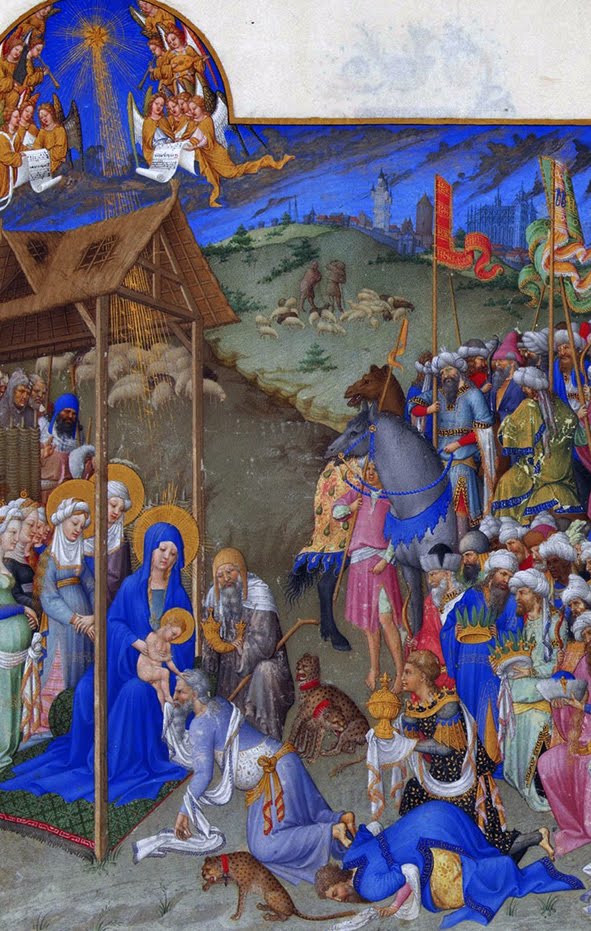
Adoration of the Magi

On entering the house, they saw the child with Mary his mother; and they knelt down and paid him homage. Then, opening their treasure chests, they offered him gifts of gold, frankincense, and myrrh. Matthew 2:1-12

In the English King James version of Matthews Gospel the ‘wise men’ from the East arrive to pay homage to the new King of the Jews and having arrived at Jesus Christ’s birthplace in Bethlehem gave gifts to celebrate the birth. The Magi are described as having followed a star to Bethlehem and there have been many attempts to link it to an astronomical event, with the most commonly cited being a conjunction of Jupiter and Saturn in 7 BCE. This conjunction fits in with Matthew's chronology pointing to Jesus Christ being born somewhere before 4 BCE, as King Herod died in that year.

The visit of the Magi or Kings bringing gifts to the new King of the Jews as described by Matthew was also a necessary fulfilment of an earlier Biblical prophesy,

        The kings of Tarshish and of the isles shall bring presents: the kings of Sheba and Seba
        shall offer gifts. Yea, all kings shall fall down before him: all nations shall serve him.
        Psalms 72:10-11:

Matthew does not specify the actual number of ‘Magi’ that actually arrived in Jerusalem but because three particular gifts, gold, frankincense and myrrh were specifically documented the tradition of Three Wise Men arose. In was only later in 6th and 8th century works that the names Caspar, Melchior and Balthasar were given to the ‘wise men’ and in Ethiopian Christianity their names are different, Hor, Karsudan, and Basanater, while the Armenians call them Kagbha, Badadakharida and Badadilma.

Possible Origins of the Three Wise Men

From Whence the Magi came? East or South-East?

Traditionally the notion of ‘wise men’ and their origins has been ascribed to the East and particularly to Zoroastrian Persia. The earliest Greek versions of Matthew's gospel had used magos, to describe the ‘wise men’ from the East and this word ultimately derived from the Avestan magauno, the priestly tribe of the Medes, the earliest Iranian empire. The magi were responsible for the Zoroastrian religious rites and particularly that of the maintenance of the sacred great fires.

At the time of the birth of Jesus Christ the Eastern or Iranian empire was controlled by the Parthians under Phraates IV (r 37-3BCE), and the power of the Zoroastrian priests was limited by a polytheistic bent in the empire. The only geographical place that might have had a significant number of Magi priests in training or officiating was at the location of what is now known as Takt-e Solayman or Throne of Solomon but then as either Mt Asnavand or Shiz (from the name of the artesian lake Čēčast ) or Adargoshnasp ( after ĀDUR GUŠNASP, the Fire of the Stallion, one of the Atas Bahrams, the three fires of the highest grade of Ancient Iran).

Takt-e Solayman and the central Artesian Well

I have been to the Takt-e Solayman.

It is a walled enclosure surrounding a deep artesian lake in a high, isolated, mountainous valley (2,200m) about 750km north-west of Teheran. Although the present visible structures are of late Parthian and Sassasinid eras the history of the site and the surrounding area as a Zoroastrian sanctuary goes back to about 1000 BCE. In early Iranian oral tradition, as later documented by Ferdowsi in the Shahnamah, King Kei Khusrau first established the Magi or mowbeds there,

Upon the spot where darkness cleared and light
First shone Khusrau commanded to erect
A dome ascending to the darksome clouds.

It was ten lassos long and broad, its circuit

Was half a rapid Arab charger's course,'

And round it there were lofty cupolas.

He brought and established there Azargashasp (ĀDUR GUŠNASP),

And round it settled the astrologers,

The archmages (mowbeds), and the men of lore.

At the time of Jesus Christ’s birth the Magi from Takt-e Solayman may have been wise but would have been dirt poor and not in the habit of giving gold, frankinsence and myrrh. If by extension kings of the Zorastrian faith were involved in the trip then there were only two that might have qualified: Parthia and Armenia and since Armenia as a province was being fought over by Parthia and Rome at the time then it is unlikely either they or their princelings would have been travelling.

(As an aside and as a pointer to Armenian Zoroastrianism I have visited the surviving Zoroastrian fire temple which still exists in the vaults beneath the Armenian Orthodox Cathedral at Etchmiadzin in Armenia and also the one at the ancient capital of the Armenian Kingdom at Ani, eastern Turkey.)

A Frankincense Tree in Arabia Felix
Arabia Felix

No it is more logical that the ‘wise men’ or perhaps early versions of ‘philosopher-kings’ had travelled by camel train along the long established Frankincense route from Arabia Felix, present day Yemen, through Petra to Jerusalem. Interestingly the Frankinsence producing Dhofar region of present day Oman, on the border with Yemen, was once part of a land that was known in Summerian texts as Magan. Perhaps the visitors were not Magi but were instead ‘of Magan’ or Magian.

Only Yemen and Oman at the time of Jesus Christ’s birth still produced Gold, Frankincense and Myrrh in relative abundance and only Yemen and Oman had a number of highly civilised and developed kingdoms (Himyar, ‘Ausan, Qataban, Saba, Ma’in and Hadramaut in Yemen and Ubar/Iram in Oman) based on the profits of the gum-resin trade, which would have been able to supply three or more ‘wise’ as well as royal visitors.


There was also a significant Jewish theological tradition in Yemen (Himyar was later to become a formal Jewish Kingdom in 400 CE) with the early contact of the Queen of Sheba (Saba) and Solomon’s court (c.8ooBCE) and the significant numbers of Jewish mercenary soldiers (and rabbi) in the Roman army under Aelius Gallus, which had invaded Saba in 25BCE.

Travelling to Jerusalem would have taken about 150 days from Marib but as part of a ‘trade’ mission it would not have been too much trouble to take time out to pay homage to the new 'King of the Jews' that biblical scholars would have predicted. There would also have been plenty of clear nights along the way for the ‘wise men’ to get the astronomy and their directions right!
Petra: Next Stop Jerusalem for the Magi!
Myrrh and Childbirth

As a final pointer to geographical origins of the Magi or Magian being from south-eastern Arabia Felix rather than eastern Persia is the Yemenese and Omanese traditional association of myrrh with childbirth and post-delivery care.

Myrrh is the gum resin from the bark of trees or shrubs of the Commiphora family. It has many traditional uses either when burned as an aromatic or powdered and applied to wounds or as a fixitive in perfumery. In traditional midwifery practice in parts of Yemen, Oman and Saudi Arabia the resin of C.mukul (or the bark of C.ornifolia) is burned and the smoke inhaled by a recently delivered mother to encourage the placenta to separate. The gum resin of C.myrrha is used when wanting to wean an infant off breast-feeding.

Myrrh Resin

Most importantly however where the Adoration of the Magi is concerned is that in Oman (Magan) and on Soqotra, the island belonging to Yemen off the coast of Somalia, the myrrh resin of C.kua is burnt ceremoniously to celebrate the safe delivery of a baby.


Wordle: magi
My First 'Wordle'

Saturday, December 11, 2010

Iran: Lapidation, taqiyeh and the Larijani Stonewall


On Thurs evening I watched a documentary on the brutal suppression of the protests that followed the Iranian presidential elections of June 2009 when unexpectedly incumbent President Ahmadinejad was announced as the winner when the majority of neutral and national observers predicted a win for Mir-Hossein Mousavi. The images that most captured that brutality were those of Basji militia members on motorcycles charging into the demonstrators slashing out with batons, and the blood coming from the mouth of 26 year-old Neda Agha-Soltan who had been fatally shot by the pillion passenger of one of those motorcycles.

In December 2009, an Iranian state television channel, Press TV aired a report about her death, saying it was ‘a western plot’. The program then argued that Agha-Soltan had ‘simulated’ the graphic images of her dying moments with accomplices, and that in fact she was killed afterwards by the very men, including a doctor, who were seen trying to save her!

What despicable nonsense!

It came as no real surprise therefore when the same Iranian Press TV yesterday aired a documentary showing Sakineh Mohammadi Ashtiani, the woman sentenced to stoning for adultery, apparently re-enacting the events leading up to the death of her former husband. This is a travesty of justice – the woman in question has already been convicted of that murder in 2006 and subsequently had her sentence of death-by-hanging commuted by an appeals court in 2007 to 10 years imprisonment – to be running a media ‘re-trial’ of the murder offence, with the sole purpose of ignoring the appellate court decision and creating an environment where a re-imposed execution order by hanging is justified and all because of umbrage at the international condemnation of the determination of the Iranian authorities to execute Ashtiani for the ‘lesser’ or ‘greater’ offence – depending on whose perspective is employed – of adultery.

(see blog of May 11, 2009 Lapidation: Loss of Reason:  https://deworde.blogspot.com/2009/05/lapidation-loss-of-reason.html)

The rationale for the clumsy and deplorable propaganda, indeed the very necessity for it, is indicative of the systemic failure of the Iranian Islamic Republic and in particular the failure of Iranian Penal or Criminal Code of 1991 and its barbaric provisions for lapidation or stoning for the crime of adultery.

Some of the Penal Code Articles dealing with how the punishment of stoning should be conducted are cited below:

Article 98 – When a person is sentenced to multiple punishments, the order of carrying out the sentences must be such that none of them prevents another, therefore if someone is sentenced to flogging and stoning, first flogging and then stoning shall be carried out.

Article 99 – If adultery by a person, who meets the marriage-bound conditions, is proven by his/her confession, then at the time of stoning the first stone will be thrown by the Shari’a judge and then by others, and if the adultery is proven by the testimony of witnesses, then first the witnesses will throw stones, then the Shari’a judge, and then others. 
Note – Absence or lack of action of the judge and witnesses in throwing the first stone shall not prevent carrying out the sentence and in any case the punishment must be executed.

Article 100 – The flogging punishment for an adulterer man shall be carried out as he is standing and wearing no clothing except to cover his genitals. Lashes must forcefully inflict his entire body except for his head, face, and genitals. An adulterer woman shall be flogged in a sitting position with her clothes bound to her body.

Article 101 – It is appropriate that the judge informs the public of the time of the punishment and it is necessary that a group of believers, not less than three people, be present when the punishment is carried out.

Article 102 – An adulterer man shall be buried in a ditch up to near his waist and an adulterer woman up to near her chest and then stoned to death.

Article 103 – In case the person sentenced to stoning escapes the ditch in which they are buried, then if the adultery is proven by testimony then they will be returned for the punishment but if it is proven by their own confession then they will not be returned. 
Note – If the person sentenced to flogging escapes they shall be returned in any case.

Article 104 – The size of the stone used in stoning shall not be too large to kill the convict by one or two throws and at the same time shall not be too small to be called a stone.

Article 105 – The Shari’a Judge can act upon his own knowledge in the cases of [defending] the God’s Rights (Haghollah) and People’s Rights (Haghonnas) and carry out the punishment constituted by the God and it is necessary that he documents his knowledge. The execution of the punishment in case of God’s Rights (Haghollah) is not contingent upon anyone’s request but in case of People’s Rights (Haghonnas) is contingent on the owner of the right.

Article 106 – Adultery during the holy times such as religious festivities and Ramadan and Friday and at holy places such as mosques will constitute flogging in addition to the regular punishment.

It is noteworthy that under the provisions that if the accused escapes and the conviction for adultery has been brought about by his own testimony rather than by witnesses then the accused may not be brought back to the pit. There is no legal definition of what constitutes an 'escape'. In addition from the very way that men or women are differently physically buried or constrained a man has a far better chance of effecting an escape than does a woman from the 'pit' .

It was hoped that the 2008 revision of the Code would remove these barbaric provisions but instead further capital offences for 'crimes' such as apostasy and witchcraft were enshrined. Everywhere people are looking, hoping, that change is coming. They are looking to leaders of the future who could, if not outright revolutionists, and would from a position of influence pursue an agenda of democratic, social and criminal reform.

Who might those leaders be?


Many now consider that the future of Iran is in the hands of the Larijani family who appear to have the blessing of supreme leader Ayatollah Khamenei and are now installed in some very important positions pursuing a conservative but pragmatic agenda.

Mohammed Javed Larijani is Secretary-General of Iran’s High Council for Human Rights. His brother Ali Ardasher Larijani is Speaker of the Parliament of Iran and former chief negotiator for Iran’s nuclear program.

Another brother Ayatollah Sadegh has been Chief Justice of Iran since August 2009, and another Bagher is a Chancellor of the Teheran University of Medical Sciences and former Deputy Minister of Health. A fifth brother Fazal is a former envoy to Canada.

In addition their sister is married to Seyed Mostafa Mohaghegh Damad a very prominent professor of jurisprudence, law and philosophy in Qom, and a staunch critic of the previous chief justice Ayatollah Hashemi Shahroudi.

The Larijani’s have been equated to the Kennedys in America. Both families in their pursuit of power appear to be happiest and most effective operating in radical stealth mode, trying to marginalise the hardline factions, while hiding their true political intentions.

It is a dangerous game though! And also it is difficult for an outsider looking in to reconsile their very public and conservative expressed views with a perception that somehow they will effect change.

For example Mohammed-Javed Larijani, the Secretary-General of Iran’s High Council for Human Rights said in a recent interview in America,

"Stoning does not mean beat her until she dies," he said. "Stoning is like flogging, like lashes. It means that you should throw a limited number of stones of limited size. She may survive; she may not."

This was so disingenuous a comment and so far removed from any normal understanding of even a basic concept of human rights – or medical reality – as to be patently untrue. Death as an outcome, as Mohammed Larijani well knew, is categorically demanded in the punishment of stoning by Article 102 of the Penal Code. There is no provision for the maximum number of stones that should be thrown (two is the minimum number) just their size!

I am not certain why Mohammed Larijani chose this tack. Perhaps is was a deliberate digression, a manifestation of the well developed Iranian trait of taqiyeh or dissimulation; and thus presenting a Larijani stonewall to their detractors or enemies within Iran!

I hope I am not misreading the situation entirely and that with the positions of Speaker of Parliament, and Chief Justice attained Mohammed-Javed and the Larijani’s can push a reformist agenda of the Iranian Penal Code and that this effort should be supported.


It has to accelerate however. There are 10 women and four men currently on death row in Iran awaiting execution by stoning for adultery.

Further Info:

http://www.youtube.com/watch?v=Shp7HE2YA_c&skipcontrinter=1


Update: Ali Larijani, by now the Iranian Security chief and more hardline than I had hoped for in 2009, was killed. Israel claimed that he was killed in an Israeli airstrike on the 16th March 2026.

Tuesday, December 07, 2010

Tiger & Steve: Bibs & Bondage


When Tiger Woods was at his predatory best – golf that is! – his caddy Steve Williams was reputed to have been – based on percentage earnings from a rampant Woods – New Zealand’s highest paid sportsman.

In general terms the relationship between a professional golfer and his bagman is a peculiar one in sport, lodged somewhere in the grey area between expediency and camaraderie, between the physical and the metaphysical.

Steve Williams, a professional caddy since his teens, an accomplished golfer in his own right as well as a national saloon-car racing champion, is a tetchy ‘bugger-the-generals’ antipodean who is highly protective of both his employer – dare I say master – as well as his own place in the scheme of things.

This egocentric perspective however seems to have resulted in an increasingly irritating behavioural quirk.

In recent years it has become almost comical to watch William’s theatrics whenever he and Woods reach the final 18th hole of any tournament. While Woods is surveying his next shot Williams is often to be seen rushing across the green – and television screens – to lay down the bag and then quickly divest himself of the ‘bib’ that identifies caddies in most of the important tournaments. Williams then tends to saunter back on to the green proper to watch the final shots being played out ready, it would appear to this onlooker, for the ‘high fives’, as a fellow ‘player’ rather than as a mere ‘bagman’.

The theatrics appear to be becoming more pronounced and were most obvious last weekend at the conclusion of the Tiger Woods hosted Chevron World Golf Challenge in California. There on the final 18th hole in regular play Williams rushed to disrobe then hovered – sans-bib – only for Graeme McDowell to sink a twenty-foot putt and send them to an extra hole. On had to go the bib again and off they trouped back to the first play-off hole where McDowell triumphed over master Woods in front of a ‘bib’ adorned and flag-holding Williams.

Williams behavioural oddity has been occasionally commented-on in online golf forums with a divided opinion between whether he is ensuring that some of his own sponsorship logos – such as that for Valvoline who obviously support his car-racing efforts – are seen or his expressed psychological need not to be seen as a mere bagman, in bondage to the arcane rules, bibs and pecking-order of the professional game.

I suspect it is something simpler or more basic than that. I would guess that five or six years ago at some PGA tournament or other Williams probably went about divesting himself of his bib before the players had left the final green and that this early disrobing had earned him a rebuke from one of the many officious ‘golfing major-generals’ that populate the final green of most tournaments. Not to be messed with by a ‘blinkered’ attitude that in another lifetime sent thousands of Australians and New Zealanders to die on the beaches of Gallipoli, Williams abreacted and determined that he would ‘stuff them.’

This ‘abreaction’ response I would have no problem with identifying with, having being brought up at a time when ‘golf’ was reserved for a very exclusive section of society who then created an ‘off-course’ etiquette which perpetuated that exclusion. It is something that I have also railed against, particularly when it is so arbitary in its application, but I do feel that the theatrical energy involved by Williams to make his ‘protest’ is becoming an irritant and could perhaps be better or more subtly employed.

Golf is a fantastic sport and now thankfully enjoyed throughout the world by men and women from right across the socio-economic ‘divide’. It also is one of the only sports where a refereeing of self, is paramount to how the game should be played and if you play in that spirit, put in all your score-cards you get the handicap you deserve. The attached ‘non-scoring’ rules governing things like dress code, behaviour on course and club-house etiquette become an impediment when they are applied without common-sense.

Golf as a professional sport has also provided an opportunity for many men and women to earn a living from the game and this includes the bagmen. Williams over-sensitive perspective will become a problem unless addressed by himself.

Bibs, latex or not, do not mean bondage.

UPDATE NOVEMBER 2015: SEE: http://www.theguardian.com/sport/2015/nov/01/tiger-woods-steve-williams-golf-out-of-the-rough-autobiography